The Asymptotic Intelligence Thesis: Rethinking the Ceiling of AGI Cognition

Authors

  • Jeffrey E. Arle, MD, PhD, FAANS, FCNS Department of Neurosurgery, BMC Brighton

DOI:

https://doi.org/10.70777/si.v2i6.16255

Keywords:

intelligence, ai benchmarks, ai limitations, Asymptotic Intelligence, Artificial General Intelligence (AGI), Scaling Laws, Diminishing Returns, Computational Thermodynamic Constraints, Physics of Computation, Algorithmic Complexity, No-Free-Lunch Theorems, Benchmarking Intelligence

Abstract

Is there an upper limit to "intelligence"? While investigations of intelligence date back at least to the 1950s, this fundamental question has never been answered. We recount key points of the history of artificial intelligence, which offer perspective on the question, and give arguments toward the thesis that "intelligence" has an asymptotic upper limit and that the current AI trend, as measured by benchmarks, is approaching this limit. Objections to the thesis are addressed and policy implications are described.
Author Biography

Jeffrey E. Arle, MD, PhD, FAANS, FCNS, Department of Neurosurgery, BMC Brighton

Dr. Arle is currently on staff as a neurosurgeon at Boston Medical Center. He was the Associate Chief of Neurosurgery at Beth Israel Deaconess Medical Center in Boston, the Chief of Neurosurgery at Mt. Auburn Hospital in Cambridge, and an Associate Professor of Neurosurgery at Harvard Medical School for 10 years and Director of Research in Neurosurgery at Lahey Clinic and an Associate Professor of Neurosurgery at Tufts University for 13 years previously. He received his BA in Biopsychology from Columbia University in 1986 and his MD and PhD from the University of Connecticut in 1992. His dissertation work for his doctorate in Biomedical Sciences was in computational neurosciences. He then went on to do a residency in neurosurgery at the University of Pennsylvania, incorporating a double fellowship in movement disorder surgery and epilepsy surgery at NYU under Drs. Patrick Kelly, Ron Alterman, and Werner Doyle, finishing in 1999.

He edited the companion text Essential Neuromodulation with Dr. Jay Shils, the first edition published by Elsevier in 2011 and the second edition in 2021. He also co-edited the textbook Innovative Neuromodulation (Elsevier, 2014) and wrote The Neuromodulation Casebook (Elsevier, 2017). He has now practiced in the field of functional neurosurgery for over 25 years and is experienced in all areas of neuromodulation from deep brain stimulators to vagus nerve, spinal cord, peripheral nerve, and motor cortex stimulators, contributing over 100 peer-reviewed publications and chapters to the literature on many aspects of the neuromodulation field. He has served as an associate editor or Section Editor at the journals Neuromodulation and Neurosurgery, a reviewer for several other journals, co-chair of the Research and Scientific Policy Committee for the International Neuromodulation Society (INS), and for 8 years on the Board of Directors for the International Society for Intraoperative Neurophysiology (ISIN).

His longstanding research interests are in the area of computational modeling in the understanding and improved design of devices used in neuromodulation treatments. He also retired in 2009 after 15 years in the Army Reserves as a Lt. Colonel, climbed 5 of the 7 continental summits and many high passes and lower peaks around the world, raced on the Nurburgring, dogsledded in the Arctic, and has been an avid sailor in the New England area for over 20 years.

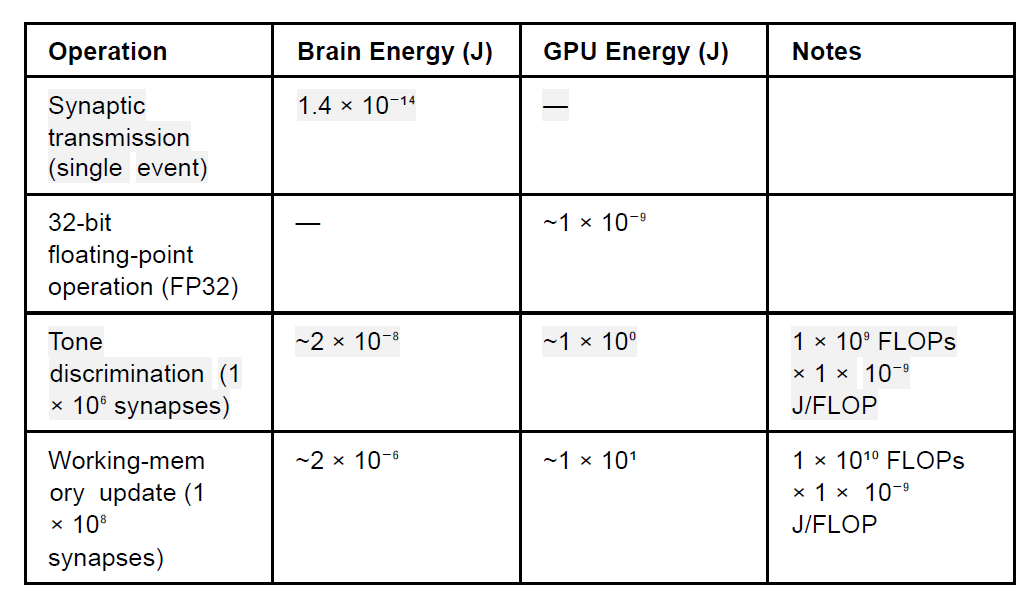
Energy per Operation: Brain vs. GPU

Downloads

Published

2025-10-23

How to Cite

Arle, J. E. (2025). The Asymptotic Intelligence Thesis: Rethinking the Ceiling of AGI Cognition. SuperIntelligence - Robotics - Safety & Alignment, 2(6). https://doi.org/10.70777/si.v2i6.16255

Similar Articles

1 2 3 4 5 6 7 8 9 > >> 

You may also start an advanced similarity search for this article.