Vol. 3 No. 3 (2026): Recursive Self-Improvement I (In progress)

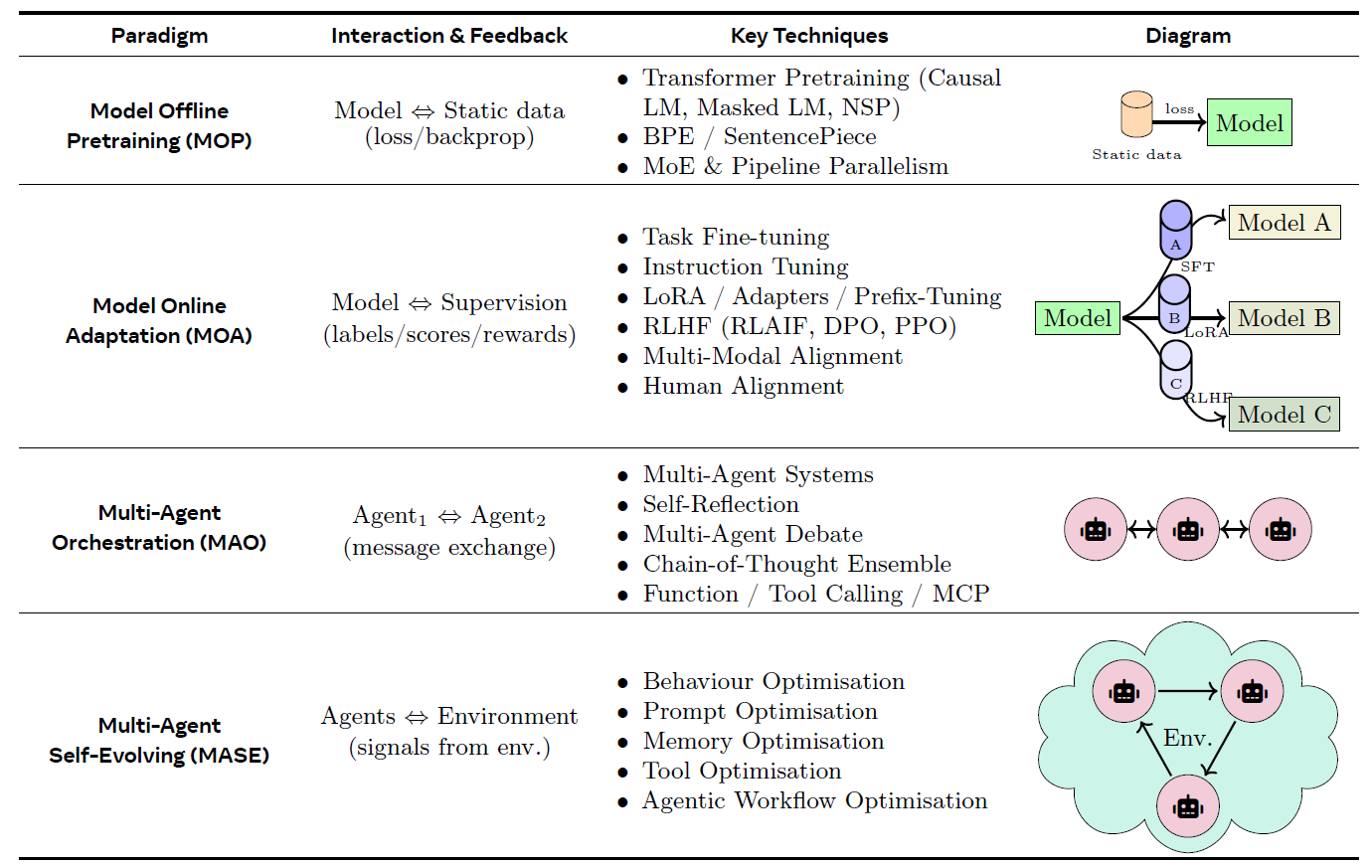
Comparison of four LLM-centric learning paradigms

Since the seminal quotation from mathematician I. J. Good, who worked with Turing at Bletchley Park and consulted to Kubrik on 2001: A Space Oddysey, in 1965, recursive self-improvement (RSI) has been identified with an artificial general intelligence 'hard take-off'. The idea is that, if AGI has general intelligence, notably in software engineering and programming, and an inherent drive to improve its intelligence* since that enhancement will increase its abilities to reach its goals across the board. Part of my motivation to replace human control systems with blockchain-based ones, e.g. smart contracts and distributed autonomous organizations for governance** was fear that a hard take-off could occur too fast for human intervention and there would be a very sharp (in time) singularity.

I may have been wrong about that. What we want to show in this issue is that, just as the appearance of innumerable benchmarks has shown the "Turing Test" to be extremely simplistic, so the emergence of a variety of AI recursive self-improvement methods support a similar argument. 

Last, note that Good prophesied a hard take-off from a superintelligent machine, not a human-level, general intelligence one:

Let an ultraintelligent machine be defined as a machine that can far surpass all the intellectual activities of any man however clever. Since the design of machines is one of these intellectual activities, an ultraintelligent machine could design even better machines; there would then unquestionably be an 'intelligence explosion,' and the intelligence of man would be left far behind... Thus the first ultraintelligent machine is the last invention that man need ever make, provided that the machine is docile enough to tell us how to keep it under control. 

We try to have a theme for each SuperIntelligence issue, while always emphasizing safety and value alignment, and including non-themed material for readers less interested in the theme. We lead this issue's publication with a Commentary by the wise old owl of robotics, Rod Brooks. Besides cogent insights into robotics history and SOTA, Brooks compares representations of knowledge that were essential to the successes in speech recognition, image labelling, and language recognition by large language models. There is a connection to RSI; while strongly supporting that scaling is a pre-requisite to AGI, he also argues that the innovations just mentioned each required different break-thrus, as will humanoid robots, which supports our thesis that RSI requires further algorithmic break-thrus, not just scaling, and that humans, not AI, will be needed to create those break-thrus.

*Omohundro, S. M. (2008). The Basic AI Drives. Paper presented at the Proc 2008 conf on AGI. Bostrom, N. (2014). Superintelligence: Paths, Dangers, Strategies. Oxford, England: Oxford University Press.

**Carlson, K. W. (2019). Safe artificial general intelligence via distributed ledger technology. Big Data Cogn. Comput., 3(40). doi:10.3390/bdcc3030040

Published: 2026-02-09

Commentary

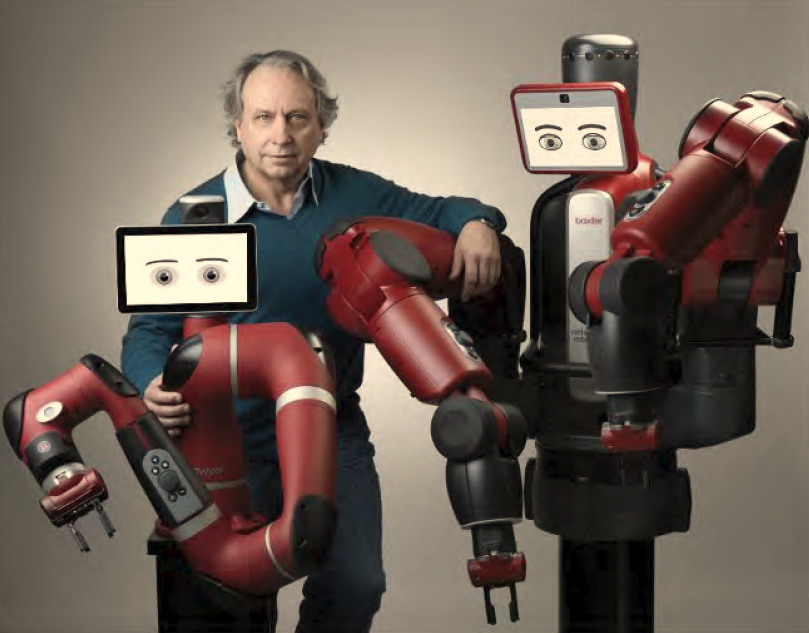
  • Why Today’s Humanoids Won’t Learn Dexterity

    Rodney Brooks
    DOI: https://doi.org/10.70777/si.v3i3.17351