
The Illusion of Thinking
Understanding the Strengths and Limitations of Reasoning Models via the Lens of Problem Complexity
DOI:
https://doi.org/10.70777/si.v2i6.15919Keywords:
llm limitations, agi, artificial general intelligence, problem complexity, Large Reasoning Models (LRMs), Reasoning Traces, Puzzle Environments, Chain-of-Thought (CoT) , Scaling Limitations, Algorithmic Reasoning, Compositional Depth, safety & value alignmentAbstract
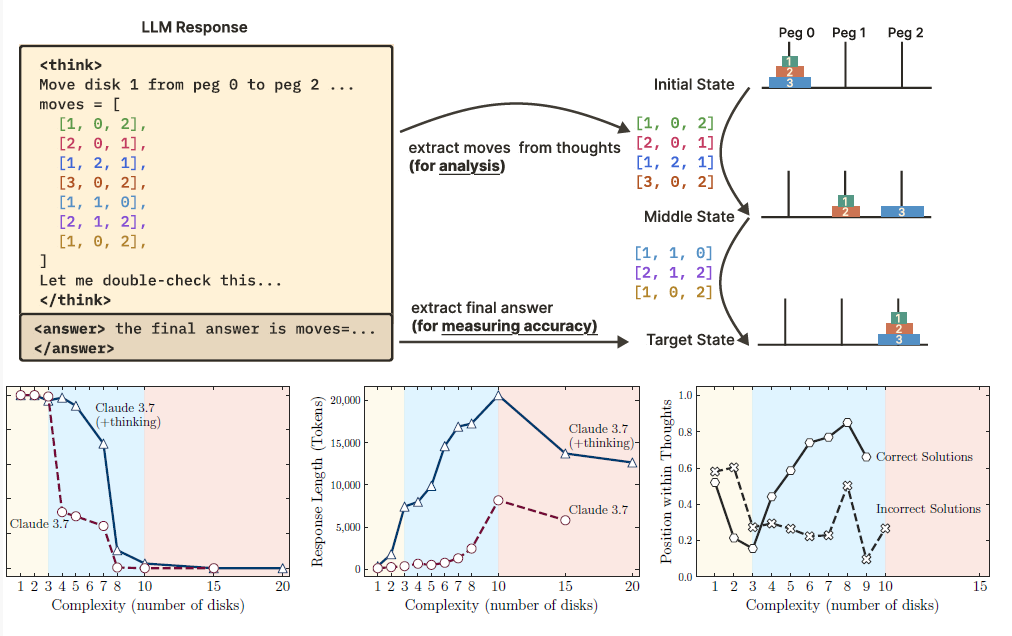
Recent generations of frontier language models have introduced Large Reasoning Models (LRMs) that generate detailed thinking processes before providing answers. While these models demonstrate improved performance on reasoning benchmarks, their fundamental capabilities, scaling properties, and limitations remain insufficiently understood. Current evaluations primarily focus on established mathematical and coding benchmarks, emphasizing final answer accuracy. However, this evaluation paradigm often suffers from data contamination and does not provide insights into the reasoning traces’ structure and quality. In this work, we systematically investigate these gaps with the help of controllable puzzle environments that allow precise manipulation of compositional complexity while maintaining consistent logical structures. This setup enables the analysis of not only final answers but also the internal reasoning traces, offering insights into how LRMs “think”. Through extensive experimentation across diverse puzzles, we show that frontier LRMs face a complete accuracy collapse beyond certain complexities. Moreover, they exhibit a counterintuitive scaling limit: their reasoning effort increases with problem complexity up to a point, then declines despite having an adequate token budget. By comparing LRMs with their standard LLM counterparts under equivalent inference compute, we identify three performance regimes: (1) lowcomplexity tasks where standard models surprisingly outperform LRMs, (2) medium-complexity tasks where additional thinking in LRMs demonstrates advantage, and (3) high-complexity tasks where both models experience complete collapse. We found that LRMs have limitations in exact computation: they fail to use explicit algorithms and reason inconsistently across puzzles. We also investigate the reasoning traces in more depth, studying the patterns of explored solutions and analyzing the models’ computational behavior, shedding light on their strengths, limitations, and ultimately raising crucial questions about their true reasoning capabilities.
References
[1] Aaron Jaech, Adam Kalai, Adam Lerer, Adam Richardson, Ahmed El-Kishky, Aiden Low, Alec Helyar, Aleksander Madry, Alex Beutel, Alex Carney, et al. Openai o1 system card. arXiv preprint arXiv:2412.16720, 2024.
[2] OpenAI. Introducing openai o1. Jan 2024.
[3] Daya Guo, Dejian Yang, Haowei Zhang, Junxiao Song, Ruoyu Zhang, Runxin Xu, Qihao Zhu, Shirong Ma, Peiyi Wang, Xiao Bi, et al. Deepseek-r1: Incentivizing reasoning capability in llms via reinforcement learning. arXiv preprint arXiv:2501.12948, 2025.
[4] Anthropic. Claude 3.7 sonnet. Feb 2025.
[5] Google. Gemini flash thinking. Google AI Blog, Jan 2025.
[6] Seyed Iman Mirzadeh, Keivan Alizadeh, Hooman Shahrokhi, Oncel Tuzel, Samy Bengio, and Mehrdad Farajtabar. GSM-symbolic: Understanding the limitations of mathematical reasoning in large language models. In The Thirteenth International Conference on Learning Representations, 2025.
[7] Francois Chollet, Mike Knoop, Gregory Kamradt, Bryan Landers, and Henry Pinkard. Arc-agi-2: A new challenge for frontier ai reasoning systems. arXiv preprint arXiv:2505.11831, 2025.
[8] Gary Marcus. Five ways in which the last 3 months — and especially the deepseek era — have vindicated "deep learning is hitting a wall". Marcus on AI (Substack), February 2025. Blog post.
[9] Marah I Abdin, Sam Ade Jacobs, Ammar Ahmad Awan, Jyoti Aneja, Ahmed Awadallah, Hany Awadalla, Nguyen Bach, Amit Bahree, Arash Bakhtiari, Harkirat S. Behl, and et. al. Phi-3 technical report: A highly capable language model locally on your phone. CoRR, abs/2404.14219, 2024.
[10] Albert Q. Jiang, Alexandre Sablayrolles, Arthur Mensch, Chris Bamford, Devendra Singh Chaplot, Diego de Las Casas, Florian Bressand, Gianna Lengyel, Guillaume Lample, Lucile
[12] Nouha Dziri, Ximing Lu, Melanie Sclar, Xiang Lorraine Li, Liwei Jiang, Bill Yuchen Lin, Sean Welleck, Peter West, Chandra Bhagavatula, Ronan Le Bras, Jena D. Hwang, Soumya Sanyal, Xiang Ren, Allyson Ettinger, Zaïd Harchaoui, and Yejin Choi. Faith and fate: Limits of transformers on compositionality. In Alice Oh, Tristan Naumann, Amir Globerson, Kate Saenko, Moritz Hardt, and Sergey Levine, editors, Advances in Neural Information Processing Systems 36: Annual Conference on Neural Information Processing Systems 2023, NeurIPS 2023, New Orleans, LA, USA, December 10 - 16, 2023, 2023.
[13] R. Thomas McCoy, Shunyu Yao, Dan Friedman, Matthew Hardy, and Thomas L. Griffiths. Embers of autoregression: Understanding large language models through the problem they are trained to solve, 2023.
[14] Marianna Nezhurina, Lucia Cipolina-Kun, Mehdi Cherti, and Jenia Jitsev. Alice in wonderland: Simple tasks showing complete reasoning breakdown in state-of-the-art large language models. arXiv preprint arXiv:2406.02061, 2024.
[15] Jason Wei, Xuezhi Wang, Dale Schuurmans, Maarten Bosma, Brian Ichter, Fei Xia, Ed H. Chi, Quoc V. Le, and Denny Zhou. Chain-of-thought prompting elicits reasoning in large language models. In Sanmi Koyejo, S. Mohamed, A. Agarwal, Danielle Belgrave, K. Cho, and A. Oh, editors, Advances in Neural Information Processing Systems 35: Annual Conference on Neural Information Processing Systems 2022, NeurIPS 2022, New Orleans, LA, USA, November 28 - December 9, 2022, 2022.
[16] Mehran Kazemi, Najoung Kim, Deepti Bhatia, Xin Xu, and Deepak Ramachandran. Lambada: Backward chaining for automated reasoning in natural language. arXiv preprint arXiv:2212.13894, 2022.
[17] Hattie Zhou, Azade Nova, Hugo Larochelle, Aaron Courville, Behnam Neyshabur, and Hanie Sedghi. Teaching algorithmic reasoning via in-context learning. arXiv preprint arXiv:2211.09066, 2022.
[18] Takeshi Kojima, Shixiang Shane Gu, Machel Reid, Yutaka Matsuo, and Yusuke Iwasawa. Large language models are zero-shot reasoners. Advances in neural information processing systems, 35:22199–22213, 2022.
[19] Yixuan Weng, Minjun
[21] Eric Zhao, Pranjal Awasthi, and Sreenivas Gollapudi. Sample, scrutinize and scale: Effective inference-time search by scaling verification. arXiv preprint arXiv:2502.01839, 2025.
[22] Eric Zelikman, Yuhuai Wu, Jesse Mu, and Noah Goodman. STar: Bootstrapping reasoning with reasoning. In Alice H. Oh, Alekh Agarwal, Danielle Belgrave, and Kyunghyun Cho, editors, Advances in Neural Information Processing Systems, 2022.
[23] Sachin Goyal, Ziwei Ji, Ankit Singh Rawat, Aditya Krishna Menon, Sanjiv Kumar, and Vaishnavh Nagarajan. Think before you speak: Training language models with pause tokens. In The Twelfth International Conference on Learning Representations, 2024.
[24] David Herel and Tomas Mikolov. Thinking tokens for language modeling. ArXiv, abs/2405.08644, 2024.
[25] Zhihong Shao, Peiyi Wang, Runxin Xu Qihao Zhu, Junxiao Song, Mingchuan Zhang, Y.K. Li, Y. Wu, and Daya Guo. Deepseekmath: Pushing the limits of mathematical reasoning in open language models, 2024.
[26] Amirhossein Kazemnejad, Milad Aghajohari, Eva Portelance, Alessandro Sordoni, Siva Reddy, Aaron Courville, and Nicolas Le Roux. Vineppo: Unlocking rl potential for llm reasoning through refined credit assignment, 2024.
[27] Nathan Lambert, Jacob Morrison, Valentina Pyatkin, Shengyi Huang, Hamish Ivison, Faeze Brahman, Lester James V. Miranda, Alisa Liu, Nouha Dziri, Shane Lyu, Yuling Gu, Saumya Malik, Victoria Graf, Jena D. Hwang, Jiangjiang Yang, Ronan Le Bras, Oyvind Tafjord, Chris Wilhelm, Luca Soldaini, Noah A. Smith, Yizhong Wang, Pradeep Dasigi, and Hannaneh Hajishirzi. Tülu 3: Pushing frontiers in open language model post-training. ArXiv, abs/2411.15124, 2024.
[28] Yanda Chen, Joe Benton, Ansh Radhakrishnan, Jonathan Uesato, Carson Denison, John Schulman, Arushi Somani, Peter Hase, Misha Wagner, Fabien Roger, et al. Reasoning models don’t always say what they think. arXiv preprint arXiv:2505.05410, 2025.
[29] Dacheng Li, Shiyi Cao, Tyler Griggs, Shu Liu, Xiangxi Mo, Eric Tang, Sumanth Hegde, Kourosh Hakhamaneshi, Shishir G Patil, Matei Zaharia, et al. Llms can easily learn to reason from demonstrations structure, not content, is what matters! arXiv preprint arXiv:2502.07374, 2025.
[30] Xingyu Chen, Jiahao Xu, Tian Liang, Zhiwei He, Jianhui Pang, Dian Yu, Linfeng Song, Qiuzhi Liu, Mengfei Zhou, Zhuosheng Zhang, et al. Do not think that much for 2+ 3=? on the overthinking of o1-like llms. arXiv preprint arXiv:2412.21187, 2024.
[31] Yang Sui, Yu-Neng Chuang, Guanchu Wang, Jiamu Zhang, Tianyi Zhang, Jiayi Yuan, Hongyi Liu, Andrew Wen, Hanjie Chen, Xia Hu, et al. Stop overthinking: A survey on efficient reasoning for large language models. arXiv preprint arXiv:2503.16419, 2025.
[32] Sara Vera Marjanović, Arkil Patel, Vaibhav Adlakha, Milad Aghajohari, Parishad BehnamGhader, Mehar Bhatia, Aditi Khandelwal, Austin Kraft, Benno Krojer, Xing Han Lù, et al. Deepseek-r1 thoughtology: Let’s< think> about llm reasoning. arXiv preprint arXiv:2504.07128, 2025.
[33] Yuxiao Qu, Matthew YR Yang, Amrith Setlur, Lewis Tunstall, Edward Emanuel Beeching, Ruslan Salakhutdinov, and Aviral Kumar. Optimizing test-time compute via meta reinforcement fine-tuning. arXiv preprint arXiv:2503.07572, 2025. 14 Livshits, David Esiobu, Dhruv Choudhary, Dhruv Mahajan, Diego Garcia-Olano, Diego Perino, Dieuwke Hupkes, Egor Lakomkin, Ehab AlBadawy, Elina Lobanova, Emily Dinan, Eric Michael Smith, Filip Radenovic, Frank Zhang, Gabriel Synnaeve, Gabrielle Lee, Georgia Lewis Anderson, Graeme Nail, Grégoire Mialon, Guan Pang, Guillem Cucurell, Hailey Nguyen, Hannah Korevaar, Hu Xu, Hugo Touvron, and et al. The llama 3 herd of models. CoRR, abs/2407.21783, 2024.
[34] Marthe Ballon, Andres Algaba, and Vincent Ginis. The relationship between reasoning and performance in large language models–o3 (mini) thinks harder, not longer. arXiv preprint arXiv:2502.15631, 2025.
[35] Yang Yue, Zhiqi Chen, Rui Lu, Andrew Zhao, Zhaokai Wang, Shiji Song, and Gao Huang. Does reinforcement learning really incentivize reasoning capacity in llms beyond the base model? arXiv preprint arXiv:2504.13837, 2025.
[36] Benjamin Estermann, Luca A. Lanzendörfer, Yannick Niedermayr, and Roger Wattenhofer. Puzzles: A
Downloads
Published
How to Cite
Issue
Section
Categories
License
Copyright (c) 2025 Parshin Shojaee , Iman Mirzadeh, Keivan Alizadeh, Maxwell Horton, Samy Bengio, Mehrdad Farajtabar

This work is licensed under a Creative Commons Attribution-NoDerivatives 4.0 International License.


