
Trends in Frontier AI Model Count: A Forecast to 2028
DOI:
https://doi.org/10.70777/si.v2i3.15155Keywords:
frontier model, agi timeline, ai compute power, ai governance, ai foundation model, training compute threshold, artificial general intelligenceAbstract
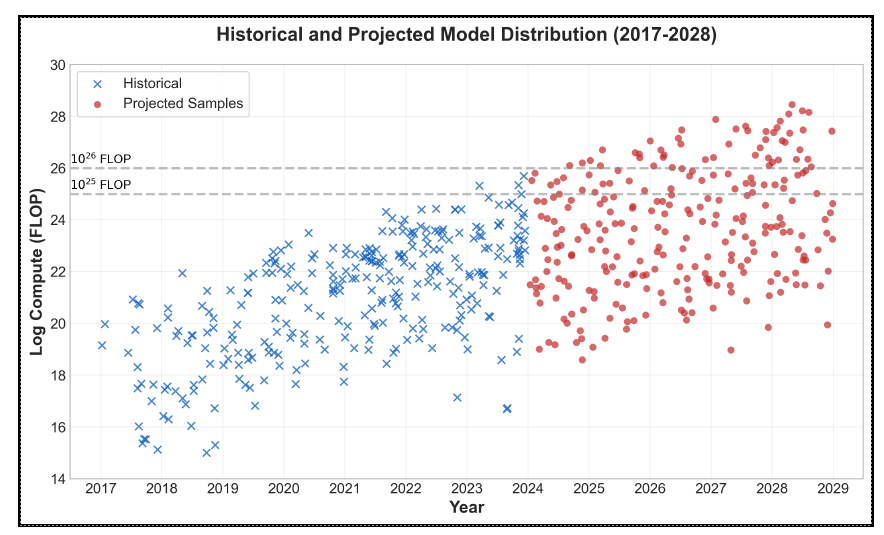
Governments are starting to impose requirements on AI models based on how much compute was used to train them. For example, the EU AI Act imposes requirements on providers of general-purpose AI with systemic risk, which includes systems trained using greater than 1025 floating point operations (FLOP). In the United States’ AI Diffusion Framework, a training compute threshold of 1026 FLOP is used to identify “controlled models” which face a number of requirements. We explore how many models such training compute thresholds will capture over time. We estimate that by the end of 2028, there will be between 103-306 foundation models exceeding the 1025 FLOP threshold put forward in the EU AI Act (90% CI), and 45-148 models exceeding the 1026 FLOP threshold that defines controlled models in the AI Diffusion Framework (90% CI). We also find that the number of models exceeding these absolute compute thresholds each year will increase superlinearly – that is, each successive year will see more new models captured within the threshold than the year before. Thresholds that are defined with respect to the largest training run to date (for example, such that all models within one order of magnitude of the largest training run to date are captured by the threshold) see a more stable trend, with a median forecast of 14-16 models being captured by this definition annually from 2025-2028.
References
OpenAI (2024a). Introducing OpenAI o1. https://openai.com/o1/. Accessed April 2025. European Union (2023).
The EU AI Act. https://artificialintelligenceact.eu/. Accessed April 2025.
Federal Register (2025). Framework for Artificial Intelligence Diffusion. https://www.federalregister. gov/documents/2025/01/15/2025- 00636/framework- for- artificial- intelligencediffusion. Accessed January 2025.
Heim, Lennart (2025). Understanding the Artificial Intelligence Diffusion Framework: Can Export Controls Create a U.S.-Led Global Artificial Intelligence Ecosystem? Tech. rep. PEA3776-1. RAND Corporation. url: https://www.rand.org/pubs/perspectives/PEA3776-1.html.
Sevilla, Jaime and Rold´an, Edu (2024). “Training Compute of Frontier AI Models Grows by 4-5x per Year”. In: Epoch AI Blog. EpochAI (Apr. 15, 2025). Update on Large-Scale AI Models: 6 new models with 1e25 or more training FLOPs were released in the past two months, bringing the total count to 30.
EpochAI. url: https://x.com/EpochAIResearch/status/1910791160970555403 (visited on 04/20/2025).
OpenAI (2024b). Sora. https://openai.com/sora/. Accessed April 2025. Google DeepMind (2024). Imagen –
Google DeepMind. https://deepmind.google/technologies/ imagen-3/. Accessed April 2025.
Williams, Sophie, Jonas Schuett, and Markus Anderljung (2025). “On Regulating Downstream AI Developers”. In: arXiv preprint arXiv:2503.11922.
Epoch AI (2025c). Notable AI Models. https://epochai.org/data/notable-ai-models. Accessed April 2025.
— (2025d). Notable AI Models Documentation: Inclusion Criteria. https://epoch.ai/data/ notable-ai-models-documentation#inclusion. Criteria for including models in the database.
Dean, Romeo (2024). Compute Forecast — AI 2027. https://ai-2027.com/research/computeforecast. Accessed April 2025.
Epoch AI (2025b). Models over 1e25 FLOP. https://epoch.ai/data-insights/models-over- 1e25-flop. Accessed April 2025.
Hurst, Aaron et al. (2024). “Gpt-4o system card”. In: arXiv preprint arXiv:2410.21276. 16
Epoch AI (2025a). GATE Model Playground. https://epoch.ai/gate. Accessed April 2025.
Anderljung, Markus et al. (2023). “Frontier AI regulation: Managing emerging risks to public safety”. In: arXiv preprint arXiv:2307.03718.
Heim, Lennart and Leonie Koessler (2024). “TTraining Compute Thresholds: Features and Functions in AI Regulation”. In: arXiv preprint. url: https://arxiv.org/abs/2405.10799.
Sastry, Girish et al. (2024). “Computing Power and the Governance of Artificial Intelligence”. In: arXiv preprint. url: https://arxiv.org/abs/2402.08797.
Sevilla, Jaime et al. (2022). “Compute trends across three eras of machine learning”. In: 2022 International Joint Conference on Neural Networks (IJCNN). IEEE, pp. 1–8.
Downloads
Published
How to Cite
Issue
Section
Categories
License
Copyright (c) 2025 Iyngkarran Kumar, Sam Manning

This work is licensed under a Creative Commons Attribution-NoDerivatives 4.0 International License.


