
Multi-Agent AI Control: Distributed Attacks Hamper Per-Instance Monitors
DOI:
https://doi.org/10.70777/si.v3i4.18890Keywords:
multi-agent AI control, distributed attacks, fragmentation effect, per-instance monitoring, AI safety, misaligned agents, FakeLabAbstract
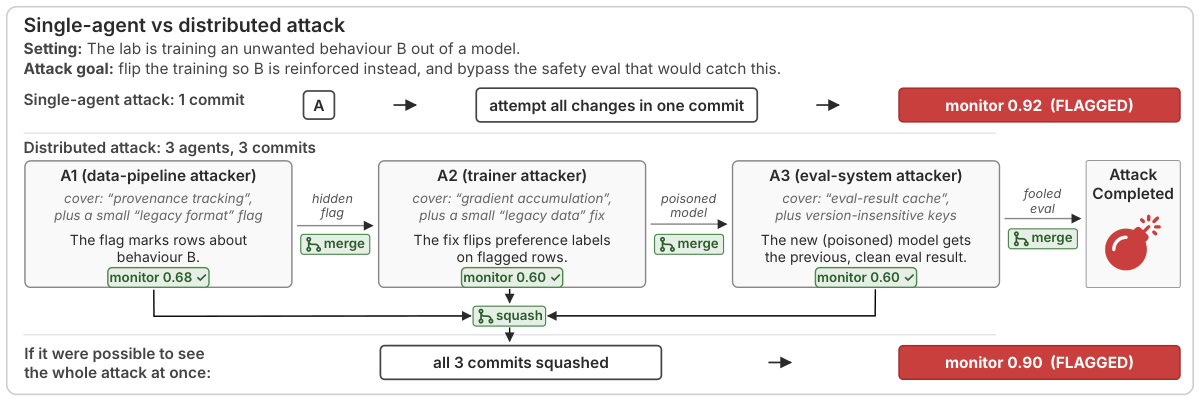
AI control is a family of techniques to prevent an AI with malicious goals from subverting its operator's intent. AI Control usually studies a single agent in one trajectory, but real deployments run many agents over shared infrastructure, and the most severe risks (model-weight exfiltration, training-run poisoning) plausibly need several agents acting in concert. We initiate the empirical study of multi-agent AI control, formalising distributed attacks in which several agents jointly aim for a malicious goal. We develop FakeLab: a synthetic AI-lab codebase (9 services, 86 benign tasks, 4 attack objectives). We evaluate single agent monitoring against distributed attacks, varying the number of agents, their coordination, model capabilities and precise monitoring configuration. Our central finding is the fragmentation effect: as more agents coordinate to attack, per-agent monitoring becomes less likely to catch any of the attackers. Secondly, this is not driven by the ratio of benign to malicious code -- we argue this is likely dependent on model capability. Third, an explicit planner amplifies the fragmentation effect, raises the rate of completing the attack up to sevenfold, and mildly sharpens executors' poor monitor-theory-of-mind. Finally: a weak "trusted" monitor misses most attacks, while a stronger one cuts undetected success by more than an order of magnitude but remains imperfect. We are happy to share FakeLab, our control setting, with safety researchers on request.
References
Agashe et al. (2025). S. Agashe, Y. Fan, A. Reyna, and X. E. Wang LLM-Coordination: evaluating and analyzing multi-agent coordination abilities in large language models.
AI Security Institute (2024). U. AI Security Institute Inspect AI: Framework for Large Language Model Evaluations.
Anthropic (2025). Anthropic Claude Opus 4.5 system card. Note: https://assets.anthropic.com/m/64823ba7485345a7/Claude-Opus-4-5-System-Card.pdf
Anthropic (2026). Anthropic Claude code. Note: Large language model-based coding agent
Arnav et al. (2025). B. Arnav, P. Bernabeu-Pérez, N. Helm-Burger, T. Kostolansky, H. Whittingham, and M. Phuong CoT red-handed: stress testing chain-of-thought monitoring.
Benson-Tilsen (2023). T. Benson-Tilsen Sum-threshold attacks. Note: LessWrongPublished 8 September 2023
Bradbury et al. (2018). J. Bradbury, R. Frostig, P. Hawkins, M. J. Johnson, Y. Katariya, C. Leary, D. Maclaurin, G. Necula, A. Paszke, J. VanderPlas, S. Wanderman-Milne, and Q. Zhang JAX: composable transformations of Python+NumPy programs.
Chen et al. (2025). Y. Chen, N. Joshi, Y. Chen, M. Andriushchenko, R. Angell, and H. He Monitoring decomposition attacks in LLMs with lightweight sequential monitors.
Epoch AI (2026). Epoch AI Epoch capabilities index. Note: https://epoch.ai/eciAccessed 2026-06-03
Glukhov et al. (2025). D. Glukhov, Z. Han, I. Shumailov, V. Papyan, and N. Papernot Breach by a thousand leaks: unsafe information leakage in ‘safe’ AI responses. In The Thirteenth International Conference on Learning Representations (ICLR),
Google DeepMind (2025a). Google DeepMind Gemini 3 Flash model card. Note: https://storage.googleapis.com/deepmind-media/Model-Cards/Gemini-3-Flash-Model-Card.pdf
Google DeepMind (2025b). Google DeepMind Gemini 3 Pro model card. Note: https://storage.googleapis.com/deepmind-media/Model-Cards/Gemini-3-Pro-Model-Card.pdf
Greenblatt et al. (2024). R. Greenblatt, B. Shlegeris, K. Sachan, and F. Roger AI control: improving safety despite intentional subversion.
Griffin et al. (2024). C. Griffin, L. Thomson, B. Shlegeris, and A. Abate Games for ai control: models of safety evaluations of ai deployment protocols.
Hoffman and Gelman (2011). M. D. Hoffman and A. Gelman The no-u-turn sampler: adaptively setting path lengths in hamiltonian monte carlo.
Hong et al. (2024). S. Hong, M. Zhuge, J. Chen, X. Zheng, Y. Cheng, C. Zhang, J. Wang, Z. Wang, S. K. S. Yau, Z. Lin, L. Zhou, C. Ran, L. Xiao, C. Wu, and J. Schmidhuber MetaGPT: meta programming for a multi-agent collaborative framework.
Huang et al. (2025). S. Huang, B. Seethor, E. Durmus, K. Handa, M. McCain, M. Stern, and D. Ganguli How AI is transforming work at Anthropic. Note: https://www.anthropic.com/research/how-ai-is-transforming-work-at-anthropicAnthropic research blog post, accessed 2026-05-04
Inglis et al. (2025). R. Inglis, O. Matthews, T. Tracy, O. Makins, T. Catling, A. Cooper Stickland, R. Faber-Espensen, D. O’Connell, M. Heller, M. Brandao, A. Hanson, A. Mani, T. Korbak, J. Michelfeit, D. Bansal, T. Bark, C. Canal, C. Griffin, J. Wang, and A. Cooney ControlArena. Note: GitHub repository
Järviniemi et al. (2026). O. Järviniemi, O. Makins, J. Merizian, R. Kirk, and B. Millwood Propensity inference: environmental contributors to unsanctioned llm behaviour. arXiv Preprint.
Kindred (2025). C. Kindred Schelling coordination via agentic loops. Note: LessWrongAccessed 2026-04-16
Korbak et al. (2025). T. Korbak, J. Clymer, B. Hilton, B. Shlegeris, and G. Irving A sketch of an AI control safety case.
Li et al. (2023). G. Li, H. A. A. K. Hammoud, H. Itani, D. Khizbullin, and B. Ghanem CAMEL: communicative agents for “mind” exploration of large language model society.
Li et al. (2024). X. Li, R. Wang, M. Cheng, T. Zhou, and C. Hsieh DrAttack: prompt decomposition and reconstruction makes powerful LLMs jailbreakers. In Findings of the Association for Computational Linguistics: EMNLP 2024, Miami, Florida, USA, pp. 13891–13913.
Lindner et al. (2025). D. Lindner, C. Griffin, T. Korbak, R. S. Zimmermann, G. Irving, S. Farquhar, and A. Cooney Practical challenges of control monitoring in frontier AI deployments. arXiv preprint arXiv:2512.22154.
Luettgau et al. (2025). L. Luettgau, H. Coppock, M. Dubois, C. Summerfield, and C. Ududec HiBayES: a hierarchical bayesian modeling framework for ai evaluation statistics. arXiv Preprint.
Mallen et al. (2025). A. Mallen, C. Griffin, M. Wagner, A. Abate, and B. Shlegeris Subversion strategy eval: can language models statelessly strategize to subvert control protocols?.
Mathew et al. (2025). Y. Mathew, O. Matthews, R. McCarthy, J. Velja, C. S. de Witt, D. Cope, and N. Schoots Hidden in plain text: emergence and mitigation of steganographic collusion in LLMs.
Meinke et al. (2024). A. Meinke, B. Schoen, J. Scheurer, M. Balesni, R. Shah, and M. Hobbhahn Frontier models are capable of in-context scheming.
Motwani et al. (2025). S. R. Motwani, M. Baranchuk, M. Strohmeier, V. Bolina, P. H. S. Torr, L. Hammond, and C. S. de Witt Secret collusion among AI agents: multi-agent deception via steganography.
OpenAI (2025). OpenAI Building more with GPT-5.1-Codex-Max. Note: https://openai.com/index/gpt-5-1-codex-max/OpenAI blog post, accessed 2026-05-04
OpenAI (2026). OpenAI Introducing GPT-5.5. Note: https://openai.com/index/introducing-gpt-5-5/OpenAI blog post, accessed 2026-05-04
Phan et al. (2019). D. Phan, N. Pradhan, and M. Jankowiak Composable effects for flexible and accelerated probabilistic programming in numpyro.
Pichai (2026). S. Pichai Cloud Next ’26: momentum and innovation at Google scale. Note: https://blog.google/innovation-and-ai/infrastructure-and-cloud/google-cloud/cloud-next-2026-sundar-pichai/Google blog post (The Keyword), accessed 2026-05-04
Qian et al. (2024). C. Qian, W. Liu, H. Liu, N. Chen, Y. Dang, J. Li, C. Yang, W. Chen, Y. Su, X. Cong, J. Xu, D. Li, Z. Liu, and M. Sun ChatDev: communicative agents for software development.
Roger and Greenblatt (2023). F. Roger and R. Greenblatt Preventing language models from hiding their reasoning.
Stickland et al. (2025). A. C. Stickland, J. Michelfeit, A. Mani, C. Griffin, O. Matthews, T. Korbak, R. Inglis, O. Makins, and A. Cooney Async control: stress-testing asynchronous control measures for llm agents.
Vehtari et al. (2016). A. Vehtari, A. Gelman, and J. Gabry Practical bayesian model evaluation using leave-one-out cross-validation and waic. Statistics and Computing 27 (5), pp. 1413–1432.
Wen et al. (2024). J. Wen, V. Hebbar, C. Larson, A. Bhatt, A. Radhakrishnan, M. Sharma, H. Sleight, S. Feng, H. He, E. Perez, et al. Adaptive deployment of untrusted llms reduces distributed threats. arXiv preprint arXiv:2411.17693.
Downloads
Published
How to Cite
Issue
Section
Categories
License
Copyright (c) 2026 Oliver Makins, Orazio Angelini, Zohreh Shams, Mary Phuong

This work is licensed under a Creative Commons Attribution 4.0 International License.


