
Unconditional Basic Meaning as Digital Public Good
DOI:
https://doi.org/10.70777/si.v2i4.16427Keywords:
AI-Powered Virtual Worlds, ikigai, ai Hyper-Personalization, Neural Interfaces, Universal Basic Income, wireheading, meaning of life, raison d'etre, ennui, public goodAbstract
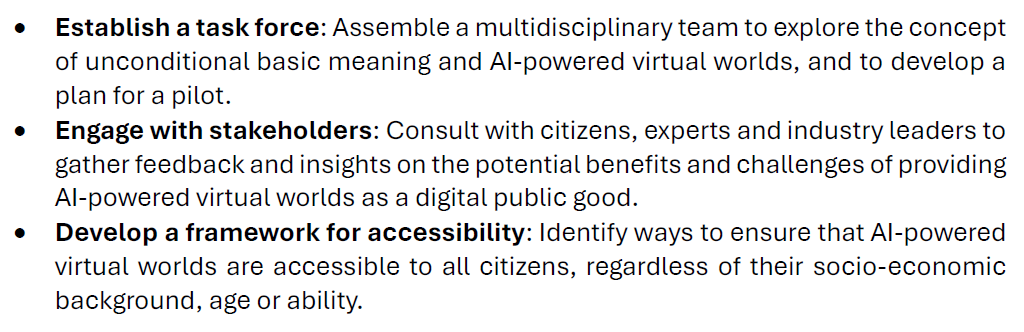
This paper introduces the concept of "unconditional basic meaning" as a digital public good, proposing that governments provide citizens with access to AI-powered virtual worlds that foster personal growth, creativity and fulfilment. As AI-supported automation increasingly displace human jobs and other daily chores, many citizens risk losing their sense of purpose or ikigai, referred to as i-risks, while having much more spare time at hand. To address this challenge, the paper argues that governments should invest in digital public goods that prioritize citizens' well-being and purpose. By providing unconditional basic meaning, governments can also help create a more just and equitable society where everyone has access to a sense of purpose and fulfilment, regardless of their background or socioeconomic status. This would not be the case if the corporate sector was to provide digital meaning. The paper also addresses a number of potential objections to this approach and concludes with specific recommendations for governments to implement AI-powered virtual worlds as a digital public good.
References
Ziesche, S., & Yampolskiy, R. (2020). Introducing the concept of ikigai to the ethics of AI and of human enhancements. In 2020 IEEE International Conference on Artificial Intelligence and Virtual Reality (AIVR) (pp. 138-145). IEEE.
Yousef, A. M. F., Alshamy, A., Tlili, A., & Metwally, A. H. S. (2025). Demystifying the new dilemma of brain rot in the digital era: A review. Brain Sciences, 15(3), 283.
Bauman, A., Bittman, M., & Gershuny, J. (2019). A short history of time use research; implications for public health. BMC public health, 19, 1-7.
United Nations Department of Economic and Social Affairs (2021). International Classification of Activities for Time-Use Statistics 2016. ST/ESA/STAT/SER.M/98
Gmyrek,P., Berg, J., Kamiński, K., Konopczyński, F., Ładna, A., Nafradi, B., ... & Troszyński, M. (2025). Generative AI and jobs: A refined global index of occupational exposure (No. 140). ILO Working Paper.
Thomson Reuters (2025). Future of Professionals Report 2025.
Lehdonvirta V, Shi LP, Hertog E, Nagase N, Ohta Y (2023) The future(s) of unpaid work: How susceptible do experts from different backgrounds think the domestic sphere is to automation? PLoS ONE 18(2): e0281282.
Charmes, J. (2015). Time use across the world: Findings of a world compilation of time use surveys. UNDP Human Development Report Office, background Paper, New York.
Engeler, I., Stan, A., Trupia, M., Quoidbach, J., & Bernardino, A. (2025). What Do You Do With the Time Saved By Generative AI Tools? Many waste it, Managers Included. SSRN.
Oakland, W. H. (1987). Theory of public goods. In Handbook of public economics (Vol. 2, pp. 485-535). Elsevier.
UNDP (2023). Digital Public Goods for the SDGs. 14
Ghatak, M., & Maniquet, F. (2019). Universal basic income: some theoretical aspects. Annual Review of Economics, 11(1), 895-928.
Standing, G. (2021). Basic income pilots: Uses, limitations and design principles. Basic Income Studies, 16(1), 75-99.
Wittgenstein, L. (1922). Tractatus logico-philosophicus.
Cerasa, A., Gaggioli, A., Marino, F., Riva, G., & Pioggia, G. (2022). The promise of the metaverse in mental health: the new era of MEDverse. Heliyon, 8(11).
Usmani, S. S., Sharath, M., & Mehendale, M. (2022). Future of mental health in the metaverse. General psychiatry, 35(4), e100825.
Buragohain, D., Khichar, S., Deng, C., Meng, Y., & Chaudhary, S. (2025). Analyzing metaverse-based digital therapies, their effectiveness, and potential risks in mental healthcare. Scientific reports, 15(1), 1-21.
Bostrom, N. (2024). Deep utopia: Life and meaning in a solved world.
Faggella, D. (2022a). Closing the Human Reward Circuit. https://danfaggella.com/reward/
Faggella, D. (2022b). You Don’t Want What You Think You Want – AI and Procedurally Generated Worlds. https://emerj.com/you-dont-want-what-you-thinkyou- want/
Ziesche, S., & Yampolskiy, R. (2025). Mapping the potential AI-driven virtual hyperpersonalised ikigai universe. In Ziesche & Yampolskiy: Considerations on the AI endgame: ethics, risks and computational frameworks (pp. 57-70). Taylor & Francis Group, Boca Raton, New York, London.
Yampolskiy, R.V. (2022). Metaverse: A Solution to the Multi-Agent Value Alignment Problem. Journal of Artificial Intelligence and Consciousness. Vol. 9, No. 3, pp. 1-11.
Kawala-Sterniuk, A., Browarska, N., Al-Bakri, A., Pelc, M., Zygarlicki, J., Sidikova, M., ... & Gorzelanczyk, E. J. (2021). Summary of over fifty years with brain-computer interfaces—a review. Brain sciences, 11(1), 43.
Siebner, H. R., Funke, K., Aberra, A. S., Antal, A., Bestmann, S., Chen, R., ... & Ugawa, Y. (2022). Transcranial magnetic stimulation of the brain: What is stimulated?–A consensus and critical position paper. Clinical Neurophysiology, 140, 59-97.
Farahany, N. A. (2023). The battle for your brain: defending the right to think freely in the age of neurotechnology. St. Martin's Press.
Yampolskiy, R. V. (2014). Utility function security in artificially intelligent agents. Journal of Experimental & Theoretical Artificial Intelligence, 26(3), 373-389.
Downloads
Published
How to Cite
Issue
Section
Categories
License
Copyright (c) 2026 Soenke Ziesche, Roman V. Yampolskiy

This work is licensed under a Creative Commons Attribution 4.0 International License.


