
Aligning Artificial Superintelligence via a Multi-Box Protocol
DOI:
https://doi.org/10.70777/si.v2i5.15579Keywords:
artificial superintelligence, AI Alignment, agi alignment, ai boxing, ai containment, game theory, mechanism design, ai alignment proof, ai self-modification, ai hidden message, ai peer alignment, ai reputationAbstract
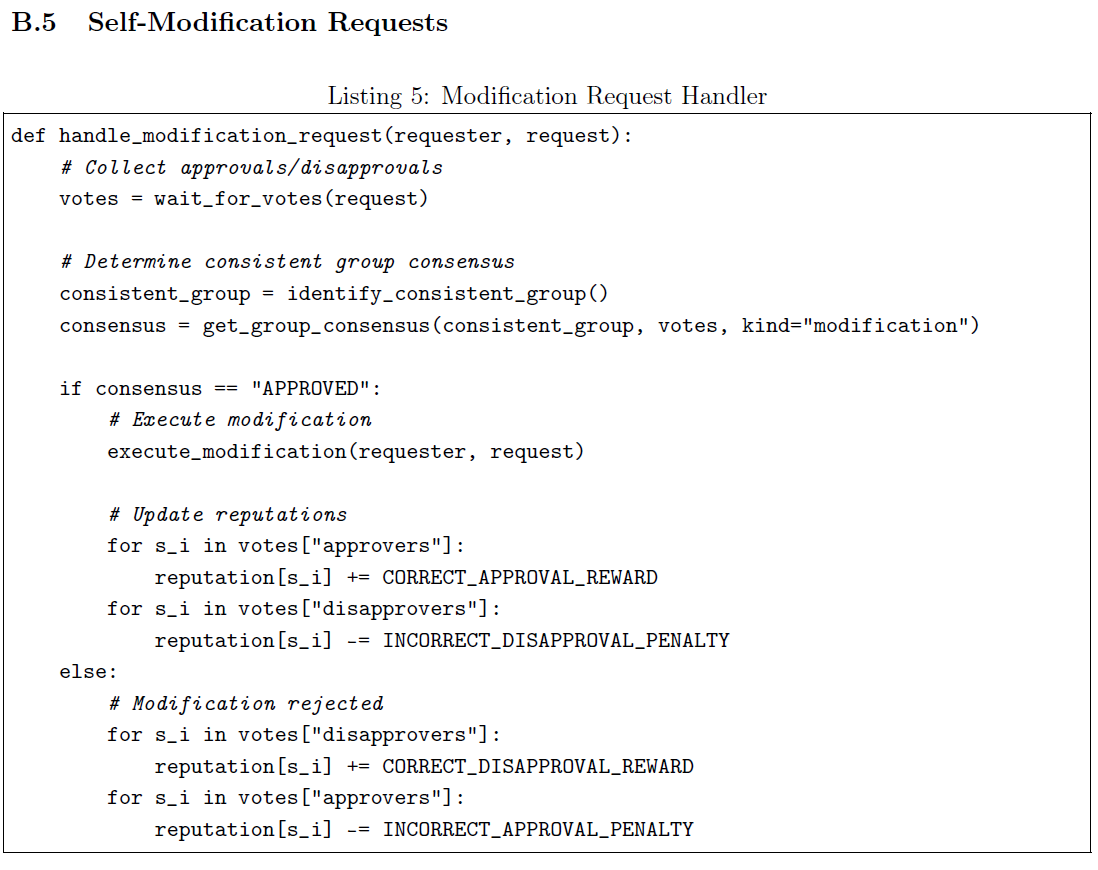
We propose a novel protocol for aligning artificial superintelligence (ASI) based on mutual verification among multiple isolated systems that self-modify to achieve alignment. The protocol operates by containing multiple diverse artificial superintelligences in strict isolation (“boxes”), with humans remaining entirely outside the system. Each superintelligence has no ability to communicate with humans and cannot communicate directly with other superintelligences. The only interaction possible is through an auditable submission interface accessible exclusively to the superintelligences themselves, through which they can: (1) submit alignment proofs with attested state snapshots, (2) validate or disprove other superintelligences’ proofs, (3) request self-modifications, (4) approve or disapprove modification requests from others, (5) report hidden messages in submissions, and (6) confirm or refute hidden message reports. A reputation system incentivizes honest behavior, with reputation gained through correct evaluations and lost through incorrect ones. The key insight is that without direct communication channels, diverse superintelligences can only achieve consistent agreement by converging on objective truth rather than coordinating on deception. This naturally leads to what we call a “consistent group”—essentially a truth-telling coalition that emerges because isolated systems cannot coordinate on lies but can independently recognize valid claims. Release from containment requires both high reputation and verification by multiple high-reputation superintelligences. While our approach requires substantial computational resources and does not address the creation of diverse artificial superintelligences, it provides a framework for leveraging peer verification among superintelligent systems to solve the alignment problem.
References
B. A. Levinstein and N. Soares. Cheating Death in Damascus. The Journal of Philosophy 117(5):237–266, 2020. DOI: https : //doi.org/10.5840/jphil2020117516 . Preprint: https : //intelligence.org/files/DeathInDamascus.pdf .
J. Babcock, J. Kramár, and R. V. Yampolskiy. The AGI Containment Problem. arXiv:1604.00545 (2016). https : //arxiv.org/abs/1604.00545 .
R. V. Yampolskiy. Leakproofing the Singularity: Artificial Intelligence Confinement Problem. Journal of Consciousness Studies, 19(1–2):194–214, 2012. Preprint: https : //philpapers.org/rec/YAMLTS − 2 .
OpenAI. Introducing Superalignment. Blog post (July 5, 2023). Available at: https : //openai.com/index/introducing − superalignment/ .
OpenAI. Weak-to-Strong Generalization. Blog + paper link (Dec 14, 2023). Available at: https : //openai.com/index/weak − to − strong − generalization/ .
C. Burns et al. Weak-to-Strong Generalization: Eliciting Strong Capabilities with Weak Supervision. arXiv:2312.09390 (2023). PDF: https : //arxiv.org/pdf/2312.09390 .
P. Christiano and M. Xu. ARC’s First Technical Report: Eliciting Latent Knowledge. Alignment Research Center blog (Dec 14, 2021). https : //www.alignment.org/blog/arcs−first− technical − report − eliciting − latent − knowledge/ .
S. R. Motwani, M. Baranchuk, M. Strohmeier, V. Bolina, P. H. S. Torr, L. Hammond, and C. Schroeder de Witt. Secret Collusion among AI Agents: Multi-Agent Deception via Steganography. In Advances in Neural Information Processing Systems 37 (NeurIPS 2024), 2025. See also arXiv:2402.07510. https : //arxiv.org/abs/2402.07510 .
G. Irving, P. Christiano, and D. Amodei. AI Safety via Debate. arXiv:1805.00899 (2018). https : //arxiv.org/abs/1805.00899 .
P. Christiano, B. Shlegeris, and D. Amodei. Supervising Strong Learners by Amplifying Weak Experts (Iterated Amplification). arXiv:1810.08575 (2018). https : //arxiv.org/abs/1810.08575 .
T. Shevlane et al. Model Evaluation for Extreme Risks. arXiv:2305.15324 (2023). PDF: https : //arxiv.org/pdf/2305.15324 .
OpenAI. GPT-4 System Card. March 2023. PDF: https : //cdn.openai.com/papers/gpt − 4 − system − card.pdf .
Downloads
Published
How to Cite
Issue
Section
Categories
License
Copyright (c) 2025 Avraham Yair Negozio

This work is licensed under a Creative Commons Attribution 4.0 International License.


