
Critical Review: Cosmos-Reason1: From Physical Common Sense To Embodied Reasoning
DOI:
https://doi.org/10.70777/si.v2i4.15315Keywords:
commonsense reasoning, grounding problem, artificial general intelligence, agi benchmarks, agi metrics, foundation model, large language model, visual reasoning, chain of thoughtAbstract
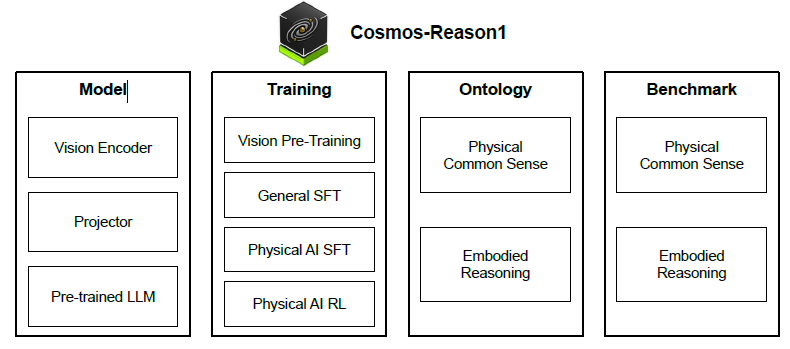
From Physical Common Sense To Embodied Reasoning is an arXiv paper, 36 pp., by a team at NVIDIA, that proposes a framework for endowing AI systems with common sense grounded in the physical world. The authors introduce a theoretical definition of common sense in terms of key capabilities, connect this theory to physical embodiment (perception and action), and implement it in Cosmos-Reason1, a family of multimodal large-language models. They design benchmarks to evaluate physical common sense and embodied reasoning. We summarize the paper’s main contributions and analyze its strengths and weaknesses. The authors define physical common sense as a general, embodiment-agnostic understanding of how the physical world works. An AI with common sense should know what is plausible or implausible in reality, independent of any specific robot or human body. Humans acquire such knowledge early - e.g. infants learn object permanence and basic gravity within months and it allows us to predict outcomes and avoid dangerous mistakes. The paper argues that equipping AI with this kind of knowledge will let it learn new skills with minimal trial-and-error and operate more safely in novel situations.
References
[1] Niket Agarwal, Arslan Ali, Maciej Bala, Yogesh Balaji, Erik Barker, Tiffany Cai, Prithvijit Chattopadhyay, Yongxin Chen, Yin Cui, Yifan Ding, et al. Cosmos world foundation model platform for physical ai. arXiv preprint arXiv:2501.03575, 2025. 14
[2] AgiBot. Agibot world colosseum. https://github.com/OpenDriveLab/AgiBot-World, 2024. 12
[3] Michael Ahn, Anthony Brohan, Noah Brown, Yevgen Chebotar, Omar Cortes, Byron David, Chelsea Finn, Chuyuan Fu, Keerthana Gopalakrishnan, Karol Hausman, et al. Do as i can, not as i say: Grounding language in robotic affordances. In CoRL, 2022. 24
[4] Jean-Baptiste Alayrac, Jeff Donahue, Pauline Luc, Antoine Miech, Iain Barr, Yana Hasson, Karel Lenc, Arthur Mensch, Katherine Millican, Malcolm Reynolds, et al. Flamingo: a visual language model for few-shot learning. In NeurIPS, 2022. 6, 9, 24
[5] H Arai, K Miwa, K Sasaki, Y Yamaguchi, et al. Covla: Comprehensive vision-language-action dataset for autonomous driving. In ICRA, 2024. 24
[6] Shuai Bai, Keqin Chen, Xuejing Liu, Jialin Wang, Wenbin Ge, Sibo Song, Kai Dang, Peng Wang, Shijie Wang, Jun Tang, et al. Qwen2.5-vl technical report. arXiv preprint arXiv:2502.13923, 2025. 9, 24
[7] Suneel Belkhale, Tianli Ding, Ted Xiao, Pierre Sermanet, Quon Vuong, Jonathan Tompson, Yevgen Chebotar, Debidatta Dwibedi, and Dorsa Sadigh. Rt-h: Action hierarchies using language. arXiv preprint arXiv:2403.01823, 2024. 16
[8] Anthony Brohan, Noah Brown, Justice Carbajal, Yevgen Chebotar, Xi Chen, Krzysztof Choromanski, Tianli Ding, Danny Driess, Avinava Dubey, Chelsea Finn, et al. Rt-2: Vision-language-action models transfer web knowledge to robotic control. arXiv preprint arXiv:2307.15818, 2023. 24
[9] Mark Chen, Jerry Tworek, Heewoo Jun, Qiming Yuan, Henrique Ponde De Oliveira Pinto, Jared Kaplan, Harri Edwards, Yuri Burda, Nicholas Joseph, Greg Brockman, et al. Evaluating large language models trained on code. arXiv preprint arXiv:2107.03374, 2021. 24
[10] Zhe Chen, Weiyun Wang, Yue Cao, Yangzhou Liu, Zhangwei Gao, Erfei Cui, Jinguo Zhu, Shenglong Ye, Hao Tian, Zhaoyang Liu, et al. Expanding performance boundaries of open-source multimodal models with model, data, and test-time scaling. arXiv preprint arXiv:2412.05271, 2024. 6, 24
[11] Zhe Chen, Jiannan Wu, Wenhai Wang, Weijie Su, Guo Chen, Sen Xing, Muyan Zhong, Qinglong Zhang, Xizhou Zhu, Lewei Lu, et al. Internvl: Scaling up vision foundation models and aligning for generic visual-linguistic tasks. In CVPR, 2024. 6, 9, 24
[12] Karl Cobbe, Vineet Kosaraju, Mohammad Bavarian, Mark Chen, Heewoo Jun, Lukasz Kaiser, Matthias Plappert, Jerry Tworek, Jacob Hilton, Reiichiro Nakano, et al. Training verifiers to solve math word problems. arXiv preprint arXiv:2110.14168, 2021. 24
[13] Wenliang Dai, Nayeon Lee, Boxin Wang, Zhuolin Yang, Zihan Liu, Jon Barker, Tuomas Rintamaki, Mohammad Shoeybi, Bryan Catanzaro, and Wei Ping. NVLM: Open frontier-class multimodal LLMs. arXiv preprint arXiv:2409.11402, 2024. 6, 8, 9, 18, 24
[14] DeepSeek-AI. Deepseek-r1: Incentivizing reasoning capability in llms via reinforcement learning. arXiv preprint arXiv:2501.12948, 2025. 1, 2, 6, 10, 12, 15, 25
[15] Danny Driess, Fei Xia, Mehdi SM Sajjadi, Corey Lynch, Aakanksha Chowdhery, et al. Palm-e: An embodied multimodal language model. In ICML, 2023. 24
[16] Amine Elhafsi, Rohan Sinha, Christopher Agia, Edward Schmerling, Issa AD Nesnas, and Marco Pavone. Semantic anomaly detection with large language models. Autonomous Robots, 2023. 24
[17] Google DeepMind Gemini Robotics Team. Gemini robotics: Bringing ai into the physical world, 2025. URL https://deepmind.google/discover/blog/ gemini-robotics-brings-ai-into-the-physical-world/. 24
[18] Aaron Grattafiori, Abhimanyu Dubey, Abhinav Jauhri, Abhinav Pandey, Abhishek Kadian, Ahmad Al-Dahle, Aiesha Letman, Akhil Mathur, Alan Schelten, Alex Vaughan, et al. The llama 3 herd of models. arXiv preprint arXiv:2407.21783, 2024. 6, 24
[19] Albert Gu and Tri Dao. Mamba: Linear-time sequence modeling with selective state spaces. In COLM, 2023. 8
[20] Tianyu Pang Haonan Wang, Chao Du. V1: Toward multimodal reasoning by designing auxiliary task, 2025. URL https://faint-basin-c34.notion.site/1b2db15ae55b800da077e70aafe40212. 25
[21] Jian Hu, Xibin Wu, Zilin Zhu, Xianyu, Weixun Wang, Dehao Zhang, and Yu Cao. Openrlhf: An easy-to-use, scalable and high-performance rlhf framework. arXiv preprint arXiv:2405.11143, 2024. 19
[22] Wenlong Huang, Pieter Abbeel, Deepak Pathak, and Igor Mordatch. Language models as zero-shot planners: Extracting actionable knowledge for embodied agents. In ICML, 2022. 24
[23] Wenxuan Huang, Bohan Jia, Zijie Zhai, Shaosheng Cao, Zheyu Ye, Fei Zhao, Yao Hu, and Shaohui Lin. Vision-r1: Incentivizing reasoning capability in multimodal large language models. arXiv preprint arXiv:2503.06749, 2025. 25
[24] Aaron Jaech, Adam Kalai, Adam Lerer, Adam Richardson, Ahmed El-Kishky, Aiden Low, Alec Helyar, Aleksander Madry, Alex Beutel, Alex Carney, et al. OpenAI o1 system card. arXiv preprint arXiv:2412.16720, 2024. 25
[25] Daniel Kahneman. Thinking, Fast and Slow. Macmillan, 2011. 3
[26] MJ Kim, K Pertsch, S Karamcheti, T Xiao, et al. Openvla: An open-source vision-language-action model. arXiv preprint arXiv:2406.09246, 2024. 24
[27] Takeshi Kojima, Shixiang Shane Gu, Machel Reid, Yutaka Matsuo, and Yusuke Iwasawa. Large language models are zero-shot reasoners. In NeurIPS, 2022. 18
[28] Woosuk Kwon, Zhuohan Li, Siyuan Zhuang, Ying Sheng, Lianmin Zheng, Cody Hao Yu, Joseph E. Gonzalez, Hao Zhang, and Ion Stoica. Efficient memory management for large language model serving with pagedattention. In SOSP, 2023. 20
[29] Yann LeCun. A path towards autonomous machine intelligence version 0.9. 2, 2022-06-27. Open Review, 2022. 3
[30] Shuang Li, Xavier Puig, Chris Paxton, Yilun Du, Clinton Wang, Linxi Fan, Tao Chen, De-An Huang, Ekin Akyürek, Anima Anandkumar, et al. Pre-trained language models for interactive decision-making. In NeurIPS, 2022. 24
[31] Y Li, Y Deng, J Zhang, J Jang, M Memme, and R Yu. Hamster: Hierarchical action models for open-world robot manipulation. In ICLR, 2025. 24
[32] Jacky Liang, Wenlong Huang, Fei Xia, Peng Xu, Karol Hausman, Brian Ichter, Pete Florence, and Andy Zeng. Code as policies: Language model programs for embodied control. In ICRA, 2022. 24
[33] Bo Liu, Yifeng Zhu, Chongkai Gao, Yihao Feng, Qiang Liu, Yuke Zhu, and Peter Stone. Libero: Benchmarking knowledge transfer for lifelong robot learning. In arXiv preprint arXiv:2306.03310, 2023. 14
[34] Haotian Liu, Chunyuan Li, Qingyang Wu, and Yong Jae Lee. Visual instruction tuning. In NeurIPS, 2023. 6, 9, 24
[35] Z Liu, A Bahety, and S Song. Reflect: Summarizing robot experiences for failure explanation and correction. In CoRL, 2023. 17, 24
[36] Zihan Liu, Yang Chen, Mohammad Shoeybi, Bryan Catanzaro, and Wei Ping. Acemath: Advancing frontier math reasoning with post-training and reward modeling. arXiv preprint arXiv:2412.15084, 2024. 25
[37] Ziyu Liu, Zeyi Sun, Yuhang Zang, Xiaoyi Dong, Yuhang Cao, Haodong Duan, Dahua Lin, and Jiaqi Wang. Visual-rft: Visual reinforcement fine-tuning. arXiv preprint arXiv:2503.01785, 2025. 25
[38] Philipp Moritz, Robert Nishihara, Stephanie Wang, Alexey Tumanov, Richard Liaw, Eric Liang, Melih Elibol, Zongheng Yang, William Paul, Michael I. Jordan, and Ion Stoica. Ray: A distributed framework for emerging ai applications. In OSDI, 2018. 19
[39] Meredith Ringel Morris, Jascha Sohl-Dickstein, Noah Fiedel, Tris Warkentin, Allan Dafoe, Aleksandra Faust, Clement Farabet, and Shane Legg. Position: Levels of agi for operationalizing progress on the path to agi. In ICML, 2024. 3
[40] Nvidia, Bo Adler, Niket Agarwal, Ashwath Aithal, Dong H Anh, Pallab Bhattacharya, Annika Brundyn, Jared Casper, Bryan Catanzaro, Sharon Clay, Jonathan Cohen, et al. Nemotron-4 340b technical report. arXiv preprint arXiv:2406.11704, 2024. 6, 8
[41] OpenAI. Learning to reason with llms, 2024. URL https://openai.com/index/ learning-to-reason-with-llms/. 1, 25
[42] Qwen-Team. Qvq: To see the world with wisdom, 2024. URL https://qwenlm.github.io/blog/ qvq-72b-preview/. 25
[43] Ronan Riochet, Mario Ynocente Castro, Mathieu Bernard, Adam Lerer, Rob Fergus, Véronique Izard, and Emmanuel Dupoux. Intphys 2019: A benchmark for visual intuitive physics understanding. TPAMI, 2021. 3
[44] Pierre Sermanet, Tianli Ding, Jeffrey Zhao, Fei Xia, Debidatta Dwibedi, Keerthana Gopalakrishnan, Christine Chan, Gabriel Dulac-Arnold, Sharath Maddineni, Nikhil J Joshi, et al. Robovqa: Multimodal long-horizon reasoning for robotics. In ICRA, 2024. 12
[45] Zhihong Shao, Peiyi Wang, Qihao Zhu, Runxin Xu, Junxiao Song, Xiao Bi, Haowei Zhang, Mingchuan Zhang, Y. K. Li, Y. Wu, and Daya Guo. Deepseekmath: Pushing the limits of mathematical reasoning in open language models. arXiv preprint arXiv:2402.03300, 2024. 19
[46] Guangming Sheng, Chi Zhang, Zilingfeng Ye, Xibin Wu, Wang Zhang, Ru Zhang, Yanghua Peng, Haibin Lin, and Chuan Wu. Hybridflow: A flexible and efficient rlhf framework. arXiv preprint arXiv: 2409.19256, 2024. 19
[47] Lucy Xiaoyang Shi, Brian Ichter, Michael Equi, Liyiming Ke, Karl Pertsch, Quan Vuong, James Tanner, Anna Walling, Haohuan Wang, Niccolo Fusai, et al. Hi robot: Open-ended instruction following with hierarchical vision-language-action models. arXiv preprint arXiv:2502.19417, 2025. 24
[48] Wenzhe Shi, Jose Caballero, Ferenc Huszár, Johannes Totz, Andrew P Aitken, Rob Bishop, Daniel Rueckert, and Zehan Wang. Real-time single image and video super-resolution using an efficient sub-pixel convolutional neural network. In CVPR, 2016. 6
[49] Mohammad Shoeybi, Mostofa Patwary, Raul Puri, Patrick LeGresley, Jared Casper, and Bryan Catanzaro. Megatron-lm: Training multi-billion parameter language models using model parallelism. arXiv preprint arXiv:1909.08053, 2019. 8
[50] Chan Hee Song, JiamanWu, ClaytonWashington, Brian M. Sadler, Wei-Lun Chao, and Yu Su. Llm-planner: Few-shot grounded planning for embodied agents with large language models. In ICCV, 2023. 24
[51] Ashish Vaswani, Noam Shazeer, Niki Parmar, Jakob Uszkoreit, Llion Jones, Aidan N Gomez, Łukasz Kaiser, and Illia Polosukhin. Attention is all you need. In NeurIPS, 2017. 7
[52] Roger Waleffe, Wonmin Byeon, Duncan Riach, Brandon Norick, Vijay Korthikanti, Tri Dao, Albert Gu, Ali Hatamizadeh, Sudhakar Singh, Deepak Narayanan, et al. An empirical study of mamba-based language models. arXiv preprint arXiv:2406.07887, 2024. 6, 8
[53] Homer Rich Walke, Kevin Black, Tony Z Zhao, Quan Vuong, Chongyi Zheng, Philippe Hansen-Estruch, Andre Wang He, Vivek Myers, Moo Jin Kim, Max Du, et al. Bridgedata v2: A dataset for robot learning at scale. In CoRL, 2023. 12
[54] Xin Wang, Taein Kwon, Mahdi Rad, Bowen Pan, Ishani Chakraborty, Sean Andrist, Dan Bohus, Ashley Feniello, Bugra Tekin, Felipe Vieira Frujeri, Neel Joshi, and Marc Pollefeys. Holoassist: an egocentric human interaction dataset for interactive ai assistants in the real world. In ICCV, 2023. 13
[55] Jason Wei, Xuezhi Wang, Dale Schuurmans, Maarten Bosma, Fei Xia, Ed Chi, Quoc V Le, Denny Zhou, et al. Chain-of-thought prompting elicits reasoning in large language models. In NeurIPS, 2022. 25
[56] Youshao Xiao, Zhenglei Zhou, Fagui Mao, Weichang Wu, Shangchun Zhao, Lin Ju, Lei Liang, Xiaolu Zhang, and Jun Zhou. An adaptive placement and parallelism framework for accelerating rlhf training, 2023. 19
[57] J Yang, R Tan, Q Wu, R Zheng, B Peng, and Y Liang. Magma: A foundation model for multimodal ai agents. In CVPR, 2025. 24
[58] Michał Zawalski, William Chen, Karl Pertsch, Oier Mees, Chelsea Finn, and Sergey Levine. Robotic control via embodied chain-of-thought reasoning. In CoRL, 2024. 12, 24
[59] Jiaxing Zhao, Xihan Wei, and Liefeng Bo. R1-omni: Explainable omni-multimodal emotion recognition with reinforcement learning. arXiv e-prints, pages arXiv–2503, 2025. 25
[60] Hengguang Zhou, Xirui Li, Ruochen Wang, Minhao Cheng, Tianyi Zhou, and Cho-Jui Hsieh. R1-zero’s" aha moment" in visual reasoning on a 2b non-sft model. arXiv preprint arXiv:2503.05132, 2025. 25
Downloads
Published
How to Cite
Issue
Section
Categories
License
Copyright (c) 2025 Kris Carlson

This work is licensed under a Creative Commons Attribution-NoDerivatives 4.0 International License.


