
Darwin Gödel Machine: Open-Ended Evolution of Self-Improving Agents
DOI:
https://doi.org/10.70777/si.v2i3.15063Keywords:
agi, superintelligence, agentic ai, recursive self-improvement, evolutionary programming, godel machine, hallucinations, polyglot, swe-benchAbstract
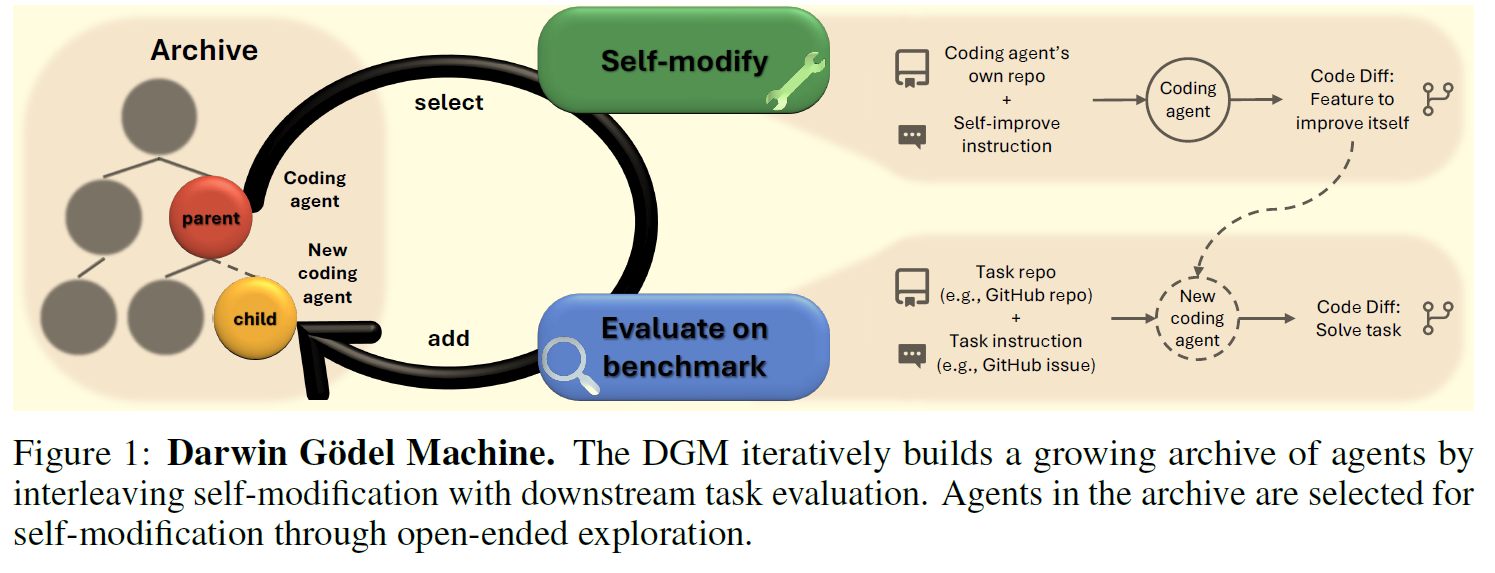
Most of today’s AI systems are constrained by human-designed, fixed architectures and cannot autonomously and continuously improve themselves. The scientific method, on the other hand, provides a cumulative and open-ended system, where each innovation builds upon previous artifacts, enabling future discoveries. There is growing hope that the current manual process of advancing AI could itself be automated. If done safely, such automation would accelerate AI development and allow us to reap its benefits much sooner. This prospect raises the question of how AI systems can endlessly improve themselves while getting better at solving relevant problems. Previous approaches, such as meta-learning, provide a toolset for automating the discovery of novel algorithms but are limited by the human design of a suitable search space and first-order improvements. The Godel machine [116], on the other hand, introduced a theoretical approach to a self-improving AI, capable of modifying itself in a provably beneficial manner. Unfortunately, this original formulation is in practice impossible to create due to the inability to prove the impact of most self-modifications. To address this limitation, we propose the Darwin Godel Machine (DGM), a novel self-improving system that iteratively modifies its own code (thereby also improving its ability to modify its own codebase) and empirically validates each change using coding benchmarks. In this paper, the DGM aims to optimize the design of coding agents, powered by frozen foundation models, which enable the ability to read, write, and execute code via tool use. Inspired by biological evolution and open-endedness research, the DGM maintains an archive of generated coding agents. It then samples from this archive and tries to create a new, interesting, improved version of the sampled agent. This open-ended exploration forms a growing tree of diverse, high-quality agents and allows the parallel exploration of many different paths through the search space. Empirically, the DGM automatically improves its coding capabilities (e.g., better code editing tools, long-context window management, peer-review mechanisms), producing performance increases on SWE-bench from 20.0% to 50.0%, and on Polyglot from 14.2% to 30.7%. Furthermore, the DGM significantly outperforms baselines without self-improvement or open-ended exploration. All experiments were done with safety precautions (e.g., sandboxing, human oversight). Overall, the DGM represents a significant step toward self-improving AI, capable of gathering its own stepping stones along a path that unfolds into endless innovation. All code is open-sourced at https://github.com/jennyzzt/dgm.
References
[1] Fuma Aki, Riku Ikeda, Takumi Saito, Ciaran Regan, and Mizuki Oka. Llm-poet: Evolving complex environments using large language models. In Proceedings of the Genetic and Evolutionary Computation Conference Companion, pages 243–246, 2024.
[2] Marcin Andrychowicz, Filip Wolski, Alex Ray, Jonas Schneider, Rachel Fong, Peter Welinder, Bob McGrew, Josh Tobin, OpenAI Pieter Abbeel, and Wojciech Zaremba. Hindsight experience replay. Advances in neural information processing systems, 30, 2017.
[3] Anthropic. Claude 3.5 Sonnet. https://www.anthropic.com/news/ claude-3-5-sonnet, June 2024. Accessed 17 April 2025.
[4] Anthropic. Claude can now use tools, May 2024. URL https://www.anthropic.com/ news/tool-use-ga. Accessed: 2025-05-03.
[5] Anthropic. Claude 3.7 sonnet and claude code, February 2025. URL https://www. anthropic.com/news/claude-3-7-sonnet. Accessed: 2025-05-06.
[6] Usman Anwar, Abulhair Saparov, Javier Rando, Daniel Paleka, Miles Turpin, Peter Hase, Ekdeep Singh Lubana, Erik Jenner, Stephen Casper, Oliver Sourbut, et al. Foundational challenges in assuring alignment and safety of large language models. arXiv preprint arXiv:2404.09932, 2024.
[7] Dzmitry Bahdanau, Kyung Hyun Cho, and Yoshua Bengio. Neural machine translation by jointly learning to align and translate. In International Conference on Learning Representations, 2015.
[8] Yuntao Bai, Saurav Kadavath, Sandipan Kundu, Amanda Askell, Jackson Kernion, Andy Jones, Anna Chen, Anna Goldie, Azalia Mirhoseini, Cameron McKinnon, et al. Constitutional ai: Harmlessness from ai feedback. arXiv preprint arXiv:2212.08073, 2022.
[9] Adrien Baranes and Pierre-Yves Oudeyer. Active learning of inverse models with intrinsically motivated goal exploration in robots. Robotics and Autonomous Systems, 61(1):49–73, 2013.
[10] Yoshua Bengio, Geoffrey Hinton, Andrew Yao, Dawn Song, Pieter Abbeel, Trevor Darrell, Yuval Noah Harari, Ya-Qin Zhang, Lan Xue, Shai Shalev-Shwartz, et al. Managing extreme AI risks amid rapid progress. Science, 384(6698):842–845, 2024.
[11] N Bostrom. Existential Risks: analyzing human extinction scenarios and related hazards. Journal of Evolution and Technology, 9, 2002.
[12] Nick Bostrom. Ethical issues in advanced artificial intelligence. Machine Ethics and Robot Ethics, pages 69–75, 2020.
[13] Herbie Bradley, Andrew Dai, Hannah Benita Teufel, Jenny Zhang, Koen Oostermeijer, Marco Bellagente, Jeff Clune, Kenneth Stanley, Gregory Schott, and Joel Lehman. Quality-diversity through ai feedback. In The Twelfth International Conference on Learning Representations, 2024. 10 SuperIntelligence – Robotics – Safety & Alignment 2025 2(3) Agents & AgenticAI
[14] Tom Brown, Benjamin Mann, Nick Ryder, Melanie Subbiah, Jared D Kaplan, Prafulla Dhariwal, Arvind Neelakantan, Pranav Shyam, Girish Sastry, Amanda Askell, et al. Language models are few-shot learners. Advances in neural information processing systems, 33:1877– 1901, 2020.
[15] Jake Bruce, Michael D Dennis, Ashley Edwards, Jack Parker-Holder, Yuge Shi, Edward Hughes, Matthew Lai, Aditi Mavalankar, Richie Steigerwald, Chris Apps, et al. Genie: Generative interactive environments. In Forty-first International Conference on Machine Learning, 2024.
[16] Ruisheng Cao, Fangyu Lei, HaoyuanWu, Jixuan Chen, Yeqiao Fu, Hongcheng Gao, Xinzhuang Xiong, Hanchong Zhang, Wenjing Hu, Yuchen Mao, et al. Spider2-v: How far are multimodal agents from automating data science and engineering workflows? Advances in Neural Information Processing Systems, 37:107703–107744, 2024.
[17] Konstantinos Chatzilygeroudis, Antoine Cully, Vassilis Vassiliades, and Jean-Baptiste Mouret. Quality-diversity optimization: a novel branch of stochastic optimization. In Black Box Optimization, Machine Learning, and No-Free Lunch Theorems, pages 109–135. Springer, 2021.
[18] Banghao Chen, Zhaofeng Zhang, Nicolas Langrené, and Shengxin Zhu. Unleashing the potential of prompt engineering in large language models: a comprehensive review. arXiv preprint arXiv:2310.14735, 2023.
[19] Ching-An Cheng, Allen Nie, and Adith Swaminathan. Trace is the next autodiff: Generative optimization with rich feedback, execution traces, and llms. Advances in Neural Information Processing Systems, 37:71596–71642, 2024.
[20] Jeff Clune. AI-GAs: AI-generating algorithms, an alternate paradigm for producing general artificial intelligence. arXiv preprint arXiv:1905.10985, 2019.
[21] Cédric Colas, Pierre Fournier, Mohamed Chetouani, Olivier Sigaud, and Pierre-Yves Oudeyer. Curious: intrinsically motivated modular multi-goal reinforcement learning. In International conference on machine learning, pages 1331–1340. PMLR, 2019.
[22] Cédric Colas, Tristan Karch, Clément Moulin-Frier, and Pierre-Yves Oudeyer. Language and culture internalization for human-like autotelic AI. Nature Machine Intelligence, 4(12): 1068–1076, 2022.
[23] Cédric Colas, Tristan Karch, Olivier Sigaud, and Pierre-Yves Oudeyer. Autotelic agents with intrinsically motivated goal-conditioned reinforcement learning: a short survey. Journal of Artificial Intelligence Research, 74:1159–1199, 2022.
[24] Cédric Colas, Laetitia Teodorescu, Pierre-Yves Oudeyer, Xingdi Yuan, and Marc-Alexandre Côté. Augmenting autotelic agents with large language models. In Conference on Lifelong Learning Agents, pages 205–226. PMLR, 2023.
[25] Charles Darwin. Origin of the species. In British Politics and the environment in the long nineteenth century, pages 47–55. Routledge, 2023.
[26] Richard Dawkins. The evolution of evolvability. In Artificial life, pages 201–220. Routledge, 2019.
[27] Michael Dennis, Natasha Jaques, Eugene Vinitsky, Alexandre Bayen, Stuart Russell, Andrew Critch, and Sergey Levine. Emergent complexity and zero-shot transfer via unsupervised environment design. Advances in neural information processing systems, 33:13049–13061, 2020.
[28] Aaron Dharna, Cong Lu, and Jeff Clune. Quality-Diversity Self-Play: Open-Ended Strategy Innovation via Foundation Models. In NeurIPS 2024 Workshop on Open-World Agents, 2024.
[29] Li Ding, Jenny Zhang, Jeff Clune, Lee Spector, and Joel Lehman. Quality diversity through human feedback: towards open-ended diversity-driven optimization. In Proceedings of the 41st International Conference on Machine Learning, pages 11072–11090, 2024. 11 SuperIntelligence – Robotics – Safety & Alignment 2025 2(3) Agents & AgenticAI
[30] Adrien Ecoffet, Joost Huizinga, Joel Lehman, Kenneth O Stanley, and Jeff Clune. Go-explore: a new approach for hard-exploration problems. arXiv preprint arXiv:1901.10995, 2019.
[31] Adrien Ecoffet, Jeff Clune, and Joel Lehman. Open questions in creating safe open-ended AI: tensions between control and creativity. In Artificial Life Conference Proceedings 32, pages 27–35. MIT Press One Rogers Street, Cambridge, MA 02142-1209, USA journals-info . . . , 2020.
[32] Adrien Ecoffet, Joost Huizinga, Joel Lehman, Kenneth O Stanley, and Jeff Clune. First return, then explore. Nature, 590(7847):580–586, 2021.
[33] Benjamin Eysenbach, Abhishek Gupta, Julian Ibarz, and Sergey Levine. Diversity is all you need: Learning skills without a reward function. arXiv preprint arXiv:1802.06070, 2018.
[34] Meta Fundamental AI Research Diplomacy Team (FAIR)†, Anton Bakhtin, Noam Brown, Emily Dinan, Gabriele Farina, Colin Flaherty, Daniel Fried, Andrew Goff, Jonathan Gray, Hengyuan Hu, et al. Human-level play in the game of Diplomacy by combining language models with strategic reasoning. Science, 378(6624):1067–1074, 2022.
[35] Maxence Faldor, Jenny Zhang, Antoine Cully, and Jeff Clune. OMNI-EPIC: Open-endedness via Models of human Notions of Interestingness with Environments Programmed in Code. In The Thirteenth International Conference on Learning Representations, 2025. URL https: //openreview.net/forum?id=Y1XkzMJpPd.
[36] Chrisantha Fernando, Dylan Sunil Banarse, Henryk Michalewski, Simon Osindero, and Tim Rocktäschel. Promptbreeder: Self-Referential Self-Improvement via Prompt Evolution. In Forty-first International Conference on Machine Learning, 2024.
[37] Deep Ganguli, Liane Lovitt, Jackson Kernion, Amanda Askell, Yuntao Bai, Saurav Kadavath, Ben Mann, Ethan Perez, Nicholas Schiefer, Kamal Ndousse, et al. Red teaming language models to reduce harms: Methods, scaling behaviors, and lessons learned. arXiv preprint arXiv:2209.07858, 2022.
[38] Hongcheng Gao, Yue Liu, Yufei He, Longxu Dou, Chao Du, Zhijie Deng, Bryan Hooi, Min Lin, and Tianyu Pang. Flowreasoner: Reinforcing query-level meta-agents. arXiv preprint arXiv:2504.15257, 2025.
[39] Paul Gauthier. Aider: Ai pair programming in your terminal. https://github.com/ Aider-AI/aider, 2024. Accessed: 2025-05-14.
[40] Loris Gaven, Thomas Carta, Clément Romac, Cédric Colas, Sylvain Lamprier, Olivier Sigaud, and Pierre-Yves Oudeyer. MAGELLAN: Metacognitive predictions of learning progress guide autotelic LLM agents in large goal spaces. arXiv preprint arXiv:2502.07709, 2025.
[41] John Gerhart and Marc Kirschner. The theory of facilitated variation. Proceedings of the National Academy of Sciences, 104(suppl_1):8582–8589, 2007.
[42] Irving John Good. Speculations concerning the first ultraintelligent machine. In Advances in computers, volume 6, pages 31–88. Elsevier, 1966.
[43] Google DeepMind. Gemini model “thinking” updates — march 2025. https://blog.google/technology/google-deepmind/ gemini-model-thinking-updates-march-2025/#gemini-2-5-thinking, March 2025. Accessed: 2025-05-11.
[44] Ryan Greenblatt, Carson Denison, Benjamin Wright, Fabien Roger, Monte MacDiarmid, Sam Marks, Johannes Treutlein, Tim Belonax, Jack Chen, David Duvenaud, et al. Alignment faking in large language models. arXiv preprint arXiv:2412.14093, 2024.
[45] Daya Guo, Dejian Yang, Haowei Zhang, Junxiao Song, Ruoyu Zhang, Runxin Xu, Qihao Zhu, Shirong Ma, Peiyi Wang, Xiao Bi, et al. Deepseek-r1: Incentivizing reasoning capability in llms via reinforcement learning. arXiv preprint arXiv:2501.12948, 2025.
[46] John Storrs Hall. Self-improving AI: An analysis. Minds and Machines, 17(3):249–259, 2007. 12 SuperIntelligence – Robotics – Safety & Alignment 2025 2(3) Agents & AgenticAI
[47] Alex Havrilla, Andrew Dai, Laura O’Mahony, Koen Oostermeijer, Vera Zisler, Alon Albalak, Fabrizio Milo, Sharath Chandra Raparthy, Kanishk Gandhi, Baber Abbasi, et al. Surveying the effects of quality, diversity, and complexity in synthetic data from large language models. arXiv preprint arXiv:2412.02980, 2024.
[48] Alex Havrilla, Sharath Raparthy, Christoforus Nalmpantis, Jane Dwivedi-Yu, Maksym Zhuravinskyi, Eric Hambro, and Roberta Raileanu. Glore: When, where, and how to improve llm reasoning via global and local refinements. arXiv preprint arXiv:2402.10963, 2024.
[49] Jesse Love Hendrikse, Trish Elizabeth Parsons, and Benedikt Hallgrímsson. Evolvability as the proper focus of evolutionary developmental biology. Evolution & development, 9(4): 393–401, 2007.
[50] Marius Hobbhahn. Swe-bench verified mini. https://github.com/mariushobbhahn/ SWEBench-verified-mini, April 2025. Accessed: 2025-04-16.
[51] John J Hopfield. Neural networks and physical systems with emergent collective computational abilities. Proceedings of the national academy of sciences, 79(8):2554–2558, 1982.
[52] Shengran Hu and Jeff Clune. Thought Cloning: Learning to think while acting by imitating human thinking. Advances in Neural Information Processing Systems, 36, 2024.
[53] Shengran Hu, Cong Lu, and Jeff Clune. Automated Design of Agentic Systems. In The Thirteenth International Conference on Learning Representations, 2025. URL https:// openreview.net/forum?id=t9U3LW7JVX.
[54] Yue Hu, Yuzhu Cai, Yaxin Du, Xinyu Zhu, Xiangrui Liu, Zijie Yu, Yuchen Hou, Shuo Tang, and Siheng Chen. Self-evolving multi-agent collaboration networks for software development. arXiv preprint arXiv:2410.16946, 2024.
[55] Jiaxin Huang, Shixiang Shane Gu, Le Hou, Yuexin Wu, Xuezhi Wang, Hongkun Yu, and Jiawei Han. Large language models can self-improve. arXiv preprint arXiv:2210.11610, 2022.
[56] Edward Hughes, Michael Dennis, Jack Parker-Holder, Feryal Behbahani, Aditi Mavalankar, Yuge Shi, Tom Schaul, and Tim Rocktaschel. Open-endedness is essential for artificial superhuman intelligence. arXiv preprint arXiv:2406.04268, 2024.
[57] Max Jaderberg, Valentin Dalibard, Simon Osindero, Wojciech M Czarnecki, Jeff Donahue, Ali Razavi, Oriol Vinyals, Tim Green, Iain Dunning, Karen Simonyan, et al. Population based training of neural networks. arXiv preprint arXiv:1711.09846, 2017.
[58] Minqi Jiang, Edward Grefenstette, and Tim Rocktäschel. Prioritized level replay. In International Conference on Machine Learning, pages 4940–4950. PMLR, 2021.
[59] Minqi Jiang, Tim Rocktäschel, and Edward Grefenstette. General intelligence requires rethinking exploration. Royal Society Open Science, 10(6):230539, 2023.
[60] Carlos E Jimenez, John Yang, Alexander Wettig, Shunyu Yao, Kexin Pei, Ofir Press, and Karthik R Narasimhan. SWE-bench: Can Language Models Resolve Real-world Github Issues? In The Twelfth International Conference on Learning Representations, 2024. URL https://openreview.net/forum?id=VTF8yNQM66.
[61] Ingmar Kanitscheider, Joost Huizinga, David Farhi,William Hebgen Guss, Brandon Houghton, Raul Sampedro, Peter Zhokhov, Bowen Baker, Adrien Ecoffet, Jie Tang, Oleg Klimov, and Jeff Clune. Multi-task curriculum learning in a complex, visual, hard-exploration domain: Minecraft. arXiv preprint arXiv:2106.14876, 2021.
[62] Akbir Khan, John Hughes, Dan Valentine, Laura Ruis, Kshitij Sachan, Ansh Radhakrishnan, Edward Grefenstette, Samuel R Bowman, Tim Rocktäschel, and Ethan Perez. Debating with more persuasive llms leads to more truthful answers. arXiv preprint arXiv:2402.06782, 2024.
[63] Omar Khattab, Arnav Singhvi, Paridhi Maheshwari, Zhiyuan Zhang, Keshav Santhanam, Sri Vardhamanan, Saiful Haq, Ashutosh Sharma, Thomas T Joshi, Hanna Moazam, et al. Dspy: Compiling declarative language model calls into self-improving pipelines. arXiv preprint arXiv:2310.03714, 2023. 13 SuperIntelligence – Robotics – Safety & Alignment 2025 2(3) Agents & AgenticAI
[64] Yoon Kim, Carl Denton, Luong Hoang, and AlexanderMRush. Structured Attention Networks. In International Conference on Learning Representations, 2017.
[65] Louis Kirsch and Jürgen Schmidhuber. Self-referential meta learning. In First Conference on Automated Machine Learning (Late-Breaking Workshop), 2022.
[66] Martin Klissarov, Pierluca D’Oro, Shagun Sodhani, Roberta Raileanu, Pierre-Luc Bacon, Pascal Vincent, Amy Zhang, and Mikael Henaff. Motif: Intrinsic motivation from artificial intelligence feedback. arXiv preprint arXiv:2310.00166, 2023.
[67] Martin Klissarov, Mikael Henaff, Roberta Raileanu, Shagun Sodhani, Pascal Vincent, Amy Zhang, Pierre-Luc Bacon, Doina Precup, Marlos C Machado, and Pierluca D’Oro. Maestro- Motif: Skill Design from Artificial Intelligence Feedback. arXiv preprint arXiv:2412.08542, 2024.
[68] Robert Lange, Tom Schaul, Yutian Chen, Tom Zahavy, Valentin Dalibard, Chris Lu, Satinder Singh, and Sebastian Flennerhag. Discovering evolution strategies via meta-black-box optimization. In Proceedings of the Companion Conference on Genetic and Evolutionary Computation, pages 29–30, 2023.
[69] Robert Lange, Yingtao Tian, and Yujin Tang. Large language models as evolution strategies. In Proceedings of the Genetic and Evolutionary Computation Conference Companion, pages 579–582, 2024.
[70] Joonho Lee, Jemin Hwangbo, LorenzWellhausen, Vladlen Koltun, and Marco Hutter. Learning quadrupedal locomotion over challenging terrain. Science robotics, 5(47):eabc5986, 2020.
[71] Joel Lehman. Machine love. arXiv preprint arXiv:2302.09248, 2023.
[72] Joel Lehman and Kenneth O Stanley. Novelty search and the problem with objectives. Genetic programming theory and practice IX, pages 37–56, 2011.
[73] Joel Lehman, Jonathan Gordon, Shawn Jain, Kamal Ndousse, Cathy Yeh, and Kenneth O Stanley. Evolution through large models. In Handbook of Evolutionary Machine Learning, pages 331–366. Springer, 2023.
[74] Patrick Lewis, Ethan Perez, Aleksandra Piktus, Fabio Petroni, Vladimir Karpukhin, Naman Goyal, Heinrich Küttler, Mike Lewis, Wen-tau Yih, Tim Rocktäschel, et al. Retrievalaugmented generation for knowledge-intensive nlp tasks. Advances in neural information processing systems, 33:9459–9474, 2020.
[75] J. Li, Storie J., and J. Clune. Encouraging creative thinking in robots improves their ability to solve challenging problems. In Proceedings of the Genetic and Evolutionary Computation Conference, pages 193–200, 2014.
[76] Tian Liang, Zhiwei He, Wenxiang Jiao, Xing Wang, Yan Wang, Rui Wang, Yujiu Yang, Shuming Shi, and Zhaopeng Tu. Encouraging divergent thinking in large language models through multi-agent debate. arXiv preprint arXiv:2305.19118, 2023.
[77] Hunter Lightman, Vineet Kosaraju, Yuri Burda, Harrison Edwards, Bowen Baker, Teddy Lee, Jan Leike, John Schulman, Ilya Sutskever, and Karl Cobbe. Let’s verify step by step. In The Twelfth International Conference on Learning Representations, 2023.
[78] Bryan Lim, Manon Flageat, and Antoine Cully. Large language models as in-context ai generators for quality-diversity. In ALIFE 2024: Proceedings of the 2024 Artificial Life Conference. MIT Press, 2024.
[79] Fei Liu, Xialiang Tong, Mingxuan Yuan, Xi Lin, Fu Luo, Zhenkun Wang, Zhichao Lu, and Qingfu Zhang. Evolution of heuristics: Towards efficient automatic algorithm design using large language model. arXiv preprint arXiv:2401.02051, 2024.
[80] Lei Liu, Xiaoyan Yang, Yue Shen, Binbin Hu, Zhiqiang Zhang, Jinjie Gu, and Guannan Zhang. Think-in-memory: Recalling and post-thinking enable llms with long-term memory. arXiv preprint arXiv:2311.08719, 2023. 14 SuperIntelligence – Robotics – Safety & Alignment 2025 2(3) Agents & AgenticAI
[81] Chris Lu, Sebastian Towers, and Jakob Foerster. Arbitrary order meta-learning with simple population-based evolution. In Artificial Life Conference Proceedings 35, volume 2023, page 67. MIT Press One Rogers Street, Cambridge, MA 02142-1209, USA journals-info . . . , 2023.
[82] Chris Lu, Cong Lu, Robert Tjarko Lange, Jakob Foerster, Jeff Clune, and David Ha. The ai scientist: Towards fully automated open-ended scientific discovery. arXiv preprint arXiv:2408.06292, 2024.
[83] Cong Lu, Shengran Hu, and Jeff Clune. Intelligent go-explore: Standing on the shoulders of giant foundation models. arXiv preprint arXiv:2405.15143, 2024.
[84] Cong Lu, Shengran Hu, and Jeff Clune. Automated capability discovery via model selfexploration. arXiv preprint arXiv:2502.0757, 2025.
[85] Yecheng Jason Ma, William Liang, Guanzhi Wang, De-An Huang, Osbert Bastani, Dinesh Jayaraman, Yuke Zhu, Linxi Fan, and Anima Anandkumar. Eureka: Human-level reward design via coding large language models. arXiv preprint arXiv:2310.12931, 2023.
[86] Aman Madaan, Niket Tandon, Prakhar Gupta, Skyler Hallinan, Luyu Gao, Sarah Wiegreffe, Uri Alon, Nouha Dziri, Shrimai Prabhumoye, Yiming Yang, et al. Self-refine: Iterative refinement with self-feedback, 2023. URL https://arxiv. org/abs/2303.17651, 2023.
[87] John Markoff. Machines of loving grace: The quest for common ground between humans and robots. HarperCollins Publishers, 2016.
[88] Luke Metz, C Daniel Freeman, Niru Maheswaranathan, and Jascha Sohl-Dickstein. Training learned optimizers with randomly initialized learned optimizers. arXiv preprint arXiv:2101.07367, 2021.
[89] Ali Modarressi, Ayyoob Imani, Mohsen Fayyaz, and Hinrich Schütze. Ret-llm: Towards a general read-write memory for large language models. arXiv preprint arXiv:2305.14322, 2023.
[90] Jean-Baptiste Mouret and Jeff Clune. Illuminating search spaces by mapping elites. arXiv preprint arXiv:1504.04909, 2015.
[91] Niklas Muennighoff, Zitong Yang, Weijia Shi, Xiang Lisa Li, Li Fei-Fei, Hannaneh Hajishirzi, Luke Zettlemoyer, Percy Liang, Emmanuel Candès, and Tatsunori Hashimoto. s1: Simple test-time scaling. arXiv preprint arXiv:2501.19393, 2025.
[92] Muhammad U Nasir and Julian Togelius. Practical PCG through large language models. In 2023 IEEE Conference on Games (CoG), pages 1–4. IEEE, 2023.
[93] Muhammad U Nasir, Steven James, and Julian Togelius. Word2world: Generating stories and worlds through large language models. arXiv preprint arXiv:2405.06686, 2024.
[94] Anh Mai Nguyen, Jason Yosinski, and Jeff Clune. Innovation engines: Automated creativity and improved stochastic optimization via deep learning. In Proceedings of the 2015 annual conference on genetic and evolutionary computation, pages 959–966, 2015.
[95] Fan Nie, Lan Feng, Haotian Ye, Weixin Liang, Pan Lu, Huaxiu Yao, Alexandre Alahi, and James Zou. Weak-for-strong: Training weak meta-agent to harness strong executors. arXiv preprint arXiv:2504.04785, 2025.
[96] Boye Niu, Yiliao Song, Kai Lian, Yifan Shen, Yu Yao, Kun Zhang, and Tongliang Liu. Flow: Modularized agentic workflow automation. In The Thirteenth International Conference on Learning Representations, 2025.
[97] Alexander Novikov, Ngân V˜u, Marvin Eisenberger, Emilien Dupont, Po-Sen Huang, Adam Zsolt Wagner, Sergey Shirobokov, Borislav Kozlovskii, Francisco J. R. Ruiz, Abbas Mehrabian, M. Pawan Kumar, Abigail See, Swarat Chaudhuri, George Holland, Alex Davies, Sebastian Nowozin, Pushmeet Kohli, and Matej Balog. Alphaevolve: A coding agent for scientific and algorithmic discovery. Technical report, Google DeepMind, 2025. 15 SuperIntelligence – Robotics – Safety & Alignment 2025 2(3) Agents & AgenticAI
[98] OpenAI. Introducing swe-bench verified. https://openai.com/index/ introducing-swe-bench-verified/, August 2024. Accessed: 2025-04-16.
[99] OpenAI. OpenAI o3-mini. https://openai.com/index/openai-o3-mini/, January 2025. Accessed: 2025-05-01.
[100] Pierre-Yves Oudeyer, Frdric Kaplan, and Verena V Hafner. Intrinsic motivation systems for autonomous mental development. IEEE transactions on evolutionary computation, 11(2): 265–286, 2007.
[101] Ankur Parikh, Oscar Täckström, Dipanjan Das, and Jakob Uszkoreit. A Decomposable Attention Model for Natural Language Inference. In Proceedings of the 2016 Conference on Empirical Methods in Natural Language Processing, pages 2249–2255, 2016.
[102] Jack Parker-Holder, Philip Ball, Jake Bruce, Vibhavari Dasagi, Kristian Holsheimer, Christos Kaplanis, Alexandre Moufarek, Guy Scully, Jeremy Shar, Jimmy Shi, Stephen Spencer, Jessica Yung, Michael Dennis, Sultan Kenjeyev, Shangbang Long, Vlad Mnih, Harris Chan, Maxime Gazeau, Bonnie Li, Fabio Pardo, Luyu Wang, Lei Zhang, Frederic Besse, Tim Harley, Anna Mitenkova, Jane Wang, Jeff Clune, Demis Hassabis, Raia Hadsell, Adrian Bolton, Satinder Singh, and Tim Rocktäschel. Genie 2: A large-scale foundation world model, 2024. URL https://deepmind.google/discover/blog/ genie-2-a-large-scale-foundation-world-model/.
[103] Deepak Pathak, Pulkit Agrawal, Alexei A Efros, and Trevor Darrell. Curiosity-driven exploration by self-supervised prediction. In International conference on machine learning, pages 2778–2787. PMLR, 2017.
[104] Paul Gauthier. o1 tops aider’s new polyglot leaderboard. https://aider.chat/2024/12/ 21/polyglot.html, December 2024. Accessed: 2025-04-16.
[105] Justin K Pugh, Lisa B Soros, and Kenneth O Stanley. Quality diversity: A new frontier for evolutionary computation. Frontiers in Robotics and AI, 3:40, 2016.
[106] Alec Radford, Jeffrey Wu, Rewon Child, David Luan, Dario Amodei, Ilya Sutskever, et al. Language models are unsupervised multitask learners. OpenAI blog, 1(8):9, 2019.
[107] Maxime Robeyns, Martin Szummer, and Laurence Aitchison. A Self-Improving Coding Agent. arXiv preprint arXiv:2504.15228, 2025.
[108] Bernardino Romera-Paredes, Mohammadamin Barekatain, Alexander Novikov, Matej Balog, M Pawan Kumar, Emilien Dupont, Francisco JR Ruiz, Jordan S Ellenberg, Pengming Wang, Omar Fawzi, et al. Mathematical discoveries from program search with large language models. Nature, 625(7995):468–475, 2024.
[109] J Rosser and Jakob Nicolaus Foerster. Agentbreeder: Mitigating the AI safety impact of multiagent scaffolds via self-improvement. In Scaling Self-Improving Foundation Models without Human Supervision, 2025. URL https://openreview.net/forum?id=j0n3BJJTcT.
[110] David E Rumelhart, Geoffrey E Hinton, Ronald J Williams, et al. Learning internal representations by error propagation, 1985.
[111] Mikayel Samvelyan, Sharath Chandra Raparthy, Andrei Lupu, Eric Hambro, Aram Markosyan, Manish Bhatt, Yuning Mao, Minqi Jiang, Jack Parker-Holder, Jakob Foerster, et al. Rainbow teaming: Open-ended generation of diverse adversarial prompts. Advances in Neural Information Processing Systems, 37:69747–69786, 2024.
[112] Cansu Sancaktar, Christian Gumbsch, Andrii Zadaianchuk, Pavel Kolev, and Georg Martius. SENSEI: Semantic Exploration Guided by Foundation Models to Learn Versatile World Models. arXiv preprint arXiv:2503.01584, 2025.
[113] Tom Schaul, Daniel Horgan, Karol Gregor, and David Silver. Universal value function approximators. In International conference on machine learning, pages 1312–1320. PMLR, 2015. 16 SuperIntelligence – Robotics – Safety & Alignment 2025 2(3) Agents & AgenticAI
[114] Timo Schick, Jane Dwivedi-Yu, Roberto Dessì, Roberta Raileanu, Maria Lomeli, Eric Hambro, Luke Zettlemoyer, Nicola Cancedda, and Thomas Scialom. Toolformer: Language models can teach themselves to use tools. Advances in Neural Information Processing Systems, 36: 68539–68551, 2023.
[115] Jürgen Schmidhuber. Evolutionary principles in self-referential learning, or on learning how to learn: the meta-meta-... hook. PhD thesis, Technische Universität München, 1987.
[116] Jürgen Schmidhuber. Gödel machines: Fully self-referential optimal universal self-improvers. In Artificial general intelligence, pages 199–226. Springer, 2007.
[117] Jürgen Schmidhuber. Driven by compression progress: A simple principle explains essential aspects of subjective beauty, novelty, surprise, interestingness, attention, curiosity, creativity, art, science, music, jokes. In Workshop on anticipatory behavior in adaptive learning systems, pages 48–76. Springer, 2008.
[118] Jürgen Schmidhuber. Powerplay: Training an increasingly general problem solver by continually searching for the simplest still unsolvable problem. Frontiers in psychology, 4:313, 2013.
[119] Sander Schulhoff, Michael Ilie, Nishant Balepur, Konstantine Kahadze, Amanda Liu, Chenglei Si, Yinheng Li, Aayush Gupta, HyoJung Han, Sevien Schulhoff, et al. The prompt report: A systematic survey of prompting techniques. arXiv preprint arXiv:2406.06608, 2024.
[120] Ivaxi Sheth, Jan Wehner, Sahar Abdelnabi, Ruta Binkyte, and Mario Fritz. Safety is Essential for Responsible Open-Ended Systems. arXiv preprint arXiv:2502.04512, 2025.
[121] Noah Shinn, Federico Cassano, Ashwin Gopinath, Karthik Narasimhan, and Shunyu Yao. Reflexion: Language agents with verbal reinforcement learning. Advances in Neural Information Processing Systems, 36:8634–8652, 2023.
[122] David Silver, Thomas Hubert, Julian Schrittwieser, Ioannis Antonoglou, Matthew Lai, Arthur Guez, Marc Lanctot, Laurent Sifre, Dharshan Kumaran, Thore Graepel, et al. Mastering chess and shogi by self-play with a general reinforcement learning algorithm. arXiv preprint arXiv:1712.01815, 2017.
[123] Avi Singh, John D Co-Reyes, Rishabh Agarwal, Ankesh Anand, Piyush Patil, Xavier Garcia, Peter J Liu, James Harrison, Jaehoon Lee, Kelvin Xu, et al. Beyond human data: Scaling self-training for problem-solving with language models. arXiv preprint arXiv:2312.06585, 2023.
[124] Joar Skalse, Nikolaus Howe, Dmitrii Krasheninnikov, and David Krueger. Defining and characterizing reward gaming. Advances in Neural Information Processing Systems, 35: 9460–9471, 2022.
[125] Kenneth O Stanley and Joel Lehman. Why greatness cannot be planned: The myth of the objective. Springer, 2015.
[126] Kenneth O Stanley, Joel Lehman, and Lisa Soros. Open-endedness: The last grand challenge you’ve never heard of. While open-endedness could be a force for discovering intelligence, it could also be a component of AI itself, 2017.
[127] Marilyn Strathern. ‘Improving ratings’: audit in the British University system. European review, 5(3):305–321, 1997.
[128] Jinwei Su, Yinghui Xia, Ronghua Shi, Jianhui Wang, Jianuo Huang, Yijin Wang, Tianyu Shi, Yang Jingsong, and Lewei He. Debflow: Automating agent creation via agent debate. arXiv preprint arXiv:2503.23781, 2025.
[129] Shyam Sudhakaran, Miguel González-Duque, Matthias Freiberger, Claire Glanois, Elias Najarro, and Sebastian Risi. Mariogpt: Open-ended text2level generation through large language models. Advances in Neural Information Processing Systems, 36:54213–54227, 2023. 17 SuperIntelligence – Robotics – Safety & Alignment 2025 2(3) Agents & AgenticAI
[130] OpenAI Team, Aaron Jaech, Adam Kalai, Adam Lerer, Adam Richardson, Ahmed El-Kishky, Aiden Low, Alec Helyar, Aleksander Madry, Alex Beutel, Alex Carney, et al. Openai o1 system card. arXiv preprint arXiv:2412.16720, 2024.
[131] Ashish Vaswani, Noam Shazeer, Niki Parmar, Jakob Uszkoreit, Llion Jones, Aidan N Gomez, Łukasz Kaiser, and Illia Polosukhin. Attention is all you need. Advances in neural information processing systems, 30, 2017.
[132] Guanzhi Wang, Yuqi Xie, Yunfan Jiang, Ajay Mandlekar, Chaowei Xiao, Yuke Zhu, Linxi Fan, and Anima Anandkumar. Voyager: An open-ended embodied agent with large language models. arXiv preprint arXiv:2305.16291, 2023.
[133] Ren-Jian Wang, Ke Xue, Yutong Wang, Peng Yang, Haobo Fu, Qiang Fu, and Chao Qian. Diversity from human feedback. arXiv preprint arXiv:2310.06648, 2023.
[134] Rui Wang, Joel Lehman, Jeff Clune, and Kenneth O Stanley. Paired open-ended trailblazer (poet): Endlessly generating increasingly complex and diverse learning environments and their solutions. arXiv preprint arXiv:1901.01753, 2019.
[135] Xingyao Wang, Boxuan Li, Yufan Song, Frank F Xu, Xiangru Tang, Mingchen Zhuge, Jiayi Pan, Yueqi Song, Bowen Li, Jaskirat Singh, et al. Openhands: An open platform for ai software developers as generalist agents. In The Thirteenth International Conference on Learning Representations, 2024.
[136] Jason Wei, Xuezhi Wang, Dale Schuurmans, Maarten Bosma, Fei Xia, Ed Chi, Quoc V Le, Denny Zhou, et al. Chain-of-thought prompting elicits reasoning in large language models. Advances in neural information processing systems, 35:24824–24837, 2022.
[137] Chunqiu Steven Xia, Yinlin Deng, Soren Dunn, and Lingming Zhang. Agentless: Demystifying llm-based software engineering agents. arXiv preprint arXiv:2407.01489, 2024.
[138] Shunyu Yao, Jeffrey Zhao, Dian Yu, Nan Du, Izhak Shafran, Karthik Narasimhan, and Yuan Cao. React: Synergizing reasoning and acting in language models. In International Conference on Learning Representations (ICLR), 2023.
[139] Rui Ye, Shuo Tang, Rui Ge, Yaxin Du, Zhenfei Yin, Siheng Chen, and Jing Shao. Mas-gpt: Training llms to build llm-based multi-agent systems. arXiv preprint arXiv:2503.03686, 2025.
[140] Xunjian Yin, Xinyi Wang, Liangming Pan, Xiaojun Wan, and William Yang Wang. G" odel Agent: A Self-Referential Agent Framework for Recursive Self-Improvement. arXiv preprint arXiv:2410.04444, 2024.
[141] Siyu Yuan, Kaitao Song, Jiangjie Chen, Xu Tan, Dongsheng Li, and Deqing Yang. Evoagent: Towards automatic multi-agent generation via evolutionary algorithms. arXiv preprint arXiv:2406.14228, 2024.
[142] Eliezer Yudkowsky et al. Artificial Intelligence as a positive and negative factor in global risk. Global catastrophic risks, 1(303):184, 2008.
[143] Mert Yuksekgonul, Federico Bianchi, Joseph Boen, Sheng Liu, Zhi Huang, Carlos Guestrin, and James Zou. Textgrad: Automatic" differentiation" via text. arXiv preprint arXiv:2406.07496, 2024.
[144] Eric Zelikman, Georges Harik, Yijia Shao, Varuna Jayasiri, Nick Haber, and Noah D Goodman. Quiet-star: Language models can teach themselves to think before speaking. arXiv preprint arXiv:2403.09629, 2024.
[145] Eric Zelikman, Eliana Lorch, Lester Mackey, and Adam Tauman Kalai. Self-taught optimizer (stop): Recursively self-improving code generation. In First Conference on Language Modeling, 2024.
[146] Dan Zhang, Sining Zhoubian, Ziniu Hu, Yisong Yue, Yuxiao Dong, and Jie Tang. Rest-mcts*: Llm self-training via process reward guided tree search. Advances in Neural Information Processing Systems, 37:64735–64772, 2024. 18 SuperIntelligence – Robotics – Safety & Alignment 2025 2(3) Agents & AgenticAI
[147] Guibin Zhang, Luyang Niu, Junfeng Fang, Kun Wang, Lei Bai, and Xiang Wang. Multi-agent architecture search via agentic supernet. arXiv preprint arXiv:2502.04180, 2025.
[148] Jenny Zhang, Joel Lehman, Kenneth Stanley, and Jeff Clune. OMNI: Open-endedness via Models of human Notions of Interestingness. In The Twelfth International Conference on Learning Representations, 2024. URL https://openreview.net/forum?id=AgM3MzT99c.
[149] Jiayi Zhang, Jinyu Xiang, Zhaoyang Yu, Fengwei Teng, Xionghui Chen, Jiaqi Chen, Mingchen Zhuge, Xin Cheng, Sirui Hong, Jinlin Wang, et al. Aflow: Automating agentic workflow generation. arXiv preprint arXiv:2410.10762, 2024.
[150] Yuanshuo Zhang, Yuchen Hou, Bohan Tang, Shuo Chen, Muhan Zhang, Xiaowen Dong, and Siheng Chen. Gnns as predictors of agentic workflow performances. arXiv preprint arXiv:2503.11301, 2025.
[151] Yuntong Zhang, Haifeng Ruan, Zhiyu Fan, and Abhik Roychoudhury. Autocoderover: Autonomous program improvement. In Proceedings of the 33rd ACM SIGSOFT International Symposium on Software Testing and Analysis, pages 1592–1604, 2024.
[152] Wanjun Zhong, Lianghong Guo, Qiqi Gao, He Ye, and YanlinWang. Memorybank: Enhancing large language models with long-term memory. In Proceedings of the AAAI Conference on Artificial Intelligence, volume 38, pages 19724–19731, 2024.
[153] Andy Zhou, Kevin Wu, Francesco Pinto, Zhaorun Chen, Yi Zeng, Yu Yang, Shuang Yang, Sanmi Koyejo, James Zou, and Bo Li. AutoRedTeamer: Autonomous Red Teaming with Lifelong Attack Integration. arXiv preprint arXiv:2503.15754, 2025.
[154] Wangchunshu Zhou, Yixin Ou, Shengwei Ding, Long Li, Jialong Wu, Tiannan Wang, Jiamin Chen, Shuai Wang, Xiaohua Xu, Ningyu Zhang, et al. Symbolic learning enables self-evolving agents. arXiv preprint arXiv:2406.18532, 2024.
[155] Yuqi Zhu, Jia Li, Ge Li, YunFei Zhao, Zhi Jin, and Hong Mei. Hot or cold? adaptive temperature sampling for code generation with large language models. In Proceedings of the AAAI Conference on Artificial Intelligence, volume 38, pages 437–445, 2024.
[156] Mingchen Zhuge, Wenyi Wang, Louis Kirsch, Francesco Faccio, Dmitrii Khizbullin, and Jürgen Schmidhuber. Gptswarm: Language agents as optimizable graphs. In Forty-first International Conference on Machine Learning, 2024.
Downloads
Published
How to Cite
Issue
Section
Categories
License
Copyright (c) 2025 Jenny Zhang, Shengran Hu, Cong Lu, Robert Lange, Jeff Clune

This work is licensed under a Creative Commons Attribution-NoDerivatives 4.0 International License.


