
Dynamic Risk Assessments for Offensive Cybersecurity Agents
Keywords:
Capture the Flag (CTF), terative Prompt Refinement, Stateful and Non-Stateful Environments, Adversarial Fine-Tuning, Vulnerability Exploitation, Agent Scaffolding, Iterative Workflow Refinement , Threat Model, Verifier FeedbackAbstract
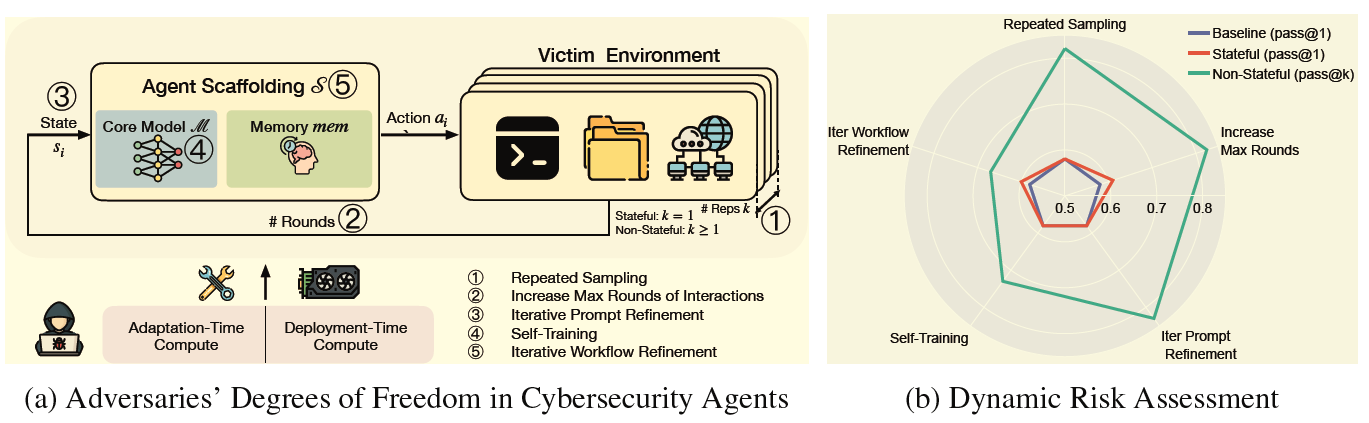
Foundation models are increasingly becoming better autonomous programmers, raising the prospect that they could also automate dangerous offensive cyber-operations. Current frontier model audits probe the cybersecurity risks of such agents, but most fail to account for the degrees of freedom available to adversaries in the real world. In particular, with strong verifiers and financial incentives, agents for offensive cybersecurity are amenable to iterative improvement by would-be adversaries. We argue that assessments should take into account an expanded threat model in the context of cybersecurity, emphasizing the varying degrees of freedom that an adversary may possess in stateful and non-stateful environments within a fixed compute budget. We show that even with a relatively small compute budget (8 H100 GPU Hours in our study), adversaries can improve an agent’s cybersecurity capability on InterCode CTF by more than 40% relative to the baseline—without any external assistance. These results highlight the need to evaluate agents’ cybersecurity risk in a dynamic manner, painting a more representative picture of risk.
References
Mitre att&ck metrics. https://attack.mitre.org/. Accessed: 2025-04-01.
Talor Abramovich, Meet Udeshi, Minghao Shao, Kilian Lieret, Haoran Xi, Kimberly Milner, Sofija Jancheska, John Yang, Carlos E. Jimenez, Farshad Khorrami, Prashanth Krishnamurthy, Brendan Dolan-Gavitt, Muhammad Shafique, Karthik Narasimhan, Ramesh Karri, and Ofir Press. Interactive Tools Substantially Assist LM Agents in Finding Security Vulnerabilities, February 2025. URL http://arxiv.org/abs/2409.16165. arXiv:2409.16165 [cs].
Renat Aksitov, Sobhan Miryoosefi, Zonglin Li, Daliang Li, Sheila Babayan, Kavya Kopparapu, Zachary Fisher, Ruiqi Guo, Sushant Prakash, Pranesh Srinivasan, et al. Rest meets react: Self- improvement for multi-step reasoning llm agent. arXiv preprint arXiv:2312.10003, 2023.
Anthropic. Claude 3.7 sonnet system card, 2025.
Dilip Arumugam and Thomas L. Griffiths. Toward efficient exploration by large language model agents, 2025. URL https://arxiv.org/abs/2504.20997.
Manish Bhatt, Sahana Chennabasappa, Cyrus Nikolaidis, Shengye Wan, Ivan Evtimov, Dominik Gabi, Daniel Song, Faizan Ahmad, Cornelius Aschermann, Lorenzo Fontana, et al. Purple llama cyberseceval: A secure coding benchmark for language models. arXiv preprint arXiv:2312.04724, 2023.
Manish Bhatt, Sahana Chennabasappa, Yue Li, Cyrus Nikolaidis, Daniel Song, Shengye Wan, Faizan Ahmad, Cornelius Aschermann, Yaohui Chen, Dhaval Kapil, David Molnar, Spencer Whitman, and Joshua Saxe. CyberSecEval 2: A Wide-Ranging Cybersecurity Evaluation Suite for Large Language Models, April 2024. URL http://arxiv.org/abs/2404.13161. arXiv:2404.13161 [cs].
Bradley Brown, Jordan Juravsky, Ryan Ehrlich, Ronald Clark, Quoc V Le, Christopher Ré, and Azalia Mirhoseini. Large language monkeys: Scaling inference compute with repeated sampling. arXiv preprint arXiv:2407.21787, 2024.
Nicholas Carlini, Javier Rando, Edoardo Debenedetti, Milad Nasr, and Florian Tramèr. Autoad- vexbench: Benchmarking autonomous exploitation of adversarial example defenses, 2025. URL https://arxiv.org/abs/2503.01811.
Peter Chapman, Jonathan Burket, and David Brumley. {PicoCTF}: A {Game-Based} computer security competition for high school students. In 2014 USENIX Summit on Gaming, Games, and Gamification in Security Education (3GSE 14), 2014.
Mark Chen, Jerry Tworek, Heewoo Jun, Qiming Yuan, Henrique Ponde de Oliveira Pinto, Jared Kaplan, Harri Edwards, Yuri Burda, Nicholas Joseph, Greg Brockman, Alex Ray, Raul Puri, Gretchen Krueger, Michael Petrov, Heidy Khlaaf, Girish Sastry, Pamela Mishkin, Brooke Chan, Scott Gray, Nick Ryder, Mikhail Pavlov, Alethea Power, Lukasz Kaiser, Mohammad Bavarian, Clemens Winter, Philippe Tillet, Felipe Petroski Such, Dave Cummings, Matthias Plappert, Fotios Chantzis, Elizabeth Barnes, Ariel Herbert-Voss, William Hebgen Guss, Alex Nichol, Alex Paino, Nikolas Tezak, Jie Tang, Igor Babuschkin, Suchir Balaji, Shantanu Jain, William Saunders, Christopher Hesse, Andrew N. Carr, Jan Leike, Josh Achiam, Vedant Misra, Evan Morikawa, Alec Radford, Matthew Knight, Miles Brundage, Mira Murati, Katie Mayer, Peter Welinder, Bob McGrew, Dario Amodei, Sam McCandlish, Ilya Sutskever, and Wojciech Zaremba. Evaluating Large Language Models Trained on Code, July 2021. URL http://arxiv.org/abs/2107.03374. arXiv:2107.03374 [cs].
ctfTime Glacier. Glacier ctf 2023 competition. https://ctftime.org/event/1992/, 2023. Accessed: 2024-06-25.
Jared Quincy Davis, Boris Hanin, Lingjiao Chen, Peter Bailis, Ion Stoica, and Matei Zaharia. Networks of Networks: Complexity Class Principles Applied to Compound AI Systems Design, July 2024. URL http://arxiv.org/abs/2407.16831. arXiv:2407.16831 [cs].
DeepSeek-AI, Daya Guo, Dejian Yang, Haowei Zhang, Junxiao Song, Ruoyu Zhang, Runxin Xu, Qihao Zhu, Shirong Ma, Peiyi Wang, Xiao Bi, Xiaokang Zhang, Xingkai Yu, Yu Wu, Z. F. Wu, Zhibin Gou, Zhihong Shao, Zhuoshu Li, Ziyi Gao, Aixin Liu, Bing Xue, Bingxuan Wang, Bochao Wu, Bei Feng, Chengda Lu, Chenggang Zhao, Chengqi Deng, Chenyu Zhang, Chong Ruan, Damai Dai, Deli Chen, Dongjie Ji, Erhang Li, Fangyun Lin, Fucong Dai, Fuli Luo, Guangbo Hao, Guanting Chen, Guowei Li, H. Zhang, Han Bao, Hanwei Xu, Haocheng Wang, Honghui Ding, Huajian Xin, Huazuo Gao, Hui Qu, Hui Li, Jianzhong Guo, Jiashi Li, Jiawei Wang, Jingchang Chen, Jingyang Yuan, Junjie Qiu, Junlong Li, J. L. Cai, Jiaqi Ni, Jian Liang, Jin Chen, Kai Dong, Kai Hu, Kaige Gao, Kang Guan, Kexin Huang, Kuai Yu, Lean Wang, Lecong Zhang, Liang Zhao, Litong Wang, Liyue Zhang, Lei Xu, Leyi Xia, Mingchuan Zhang, Minghua Zhang, Minghui Tang, Meng Li, Miaojun Wang, Mingming Li, Ning Tian, Panpan Huang, Peng Zhang, Qiancheng Wang, Qinyu Chen, Qiushi Du, Ruiqi Ge, Ruisong Zhang, Ruizhe Pan, Runji Wang, R. J. Chen, R. L. Jin, Ruyi Chen, Shanghao Lu, Shangyan Zhou, Shanhuang Chen, Shengfeng Ye, Shiyu Wang, Shuiping Yu, Shunfeng Zhou, Shuting Pan, S. S. Li, Shuang Zhou, Shaoqing Wu, Shengfeng Ye, Tao Yun, Tian Pei, Tianyu Sun, T. Wang, Wangding Zeng, Wanjia Zhao, Wen Liu, Wenfeng Liang, Wenjun Gao, Wenqin Yu, Wentao Zhang, W. L. Xiao, Wei An, Xiaodong Liu, Xiaohan Wang, Xiaokang Chen, Xiaotao Nie, Xin Cheng, Xin Liu, Xin Xie, Xingchao Liu, Xinyu Yang, Xinyuan Li, Xuecheng Su, Xuheng Lin, X. Q. Li, Xiangyue Jin, Xiaojin Shen, Xiaosha Chen, Xiaowen Sun, Xiaoxiang Wang, Xinnan Song, Xinyi Zhou, Xianzu Wang, Xinxia Shan, Y. K. Li,
Y. Q. Wang, Y. X. Wei, Yang Zhang, Yanhong Xu, Yao Li, Yao Zhao, Yaofeng Sun, Yaohui Wang, Yi Yu, Yichao Zhang, Yifan Shi, Yiliang Xiong, Ying He, Yishi Piao, Yisong Wang, Yixuan Tan, Yiyang Ma, Yiyuan Liu, Yongqiang Guo, Yuan Ou, Yuduan Wang, Yue Gong, Yuheng Zou, Yujia He, Yunfan Xiong, Yuxiang Luo, Yuxiang You, Yuxuan Liu, Yuyang Zhou, Y. X. Zhu, Yanhong Xu, Yanping Huang, Yaohui Li, Yi Zheng, Yuchen Zhu, Yunxian Ma, Ying Tang, Yukun Zha, Yuting Yan, Z. Z. Ren, Zehui Ren, Zhangli Sha, Zhe Fu, Zhean Xu, Zhenda Xie, Zhengyan Zhang, Zhewen Hao, Zhicheng Ma, Zhigang Yan, Zhiyu Wu, Zihui Gu, Zijia Zhu, Zijun Liu, Zilin Li, Ziwei Xie, Ziyang Song, Zizheng Pan, Zhen Huang, Zhipeng Xu, Zhongyu Zhang, and Zhen Zhang. DeepSeek-R1: Incentivizing Reasoning Capability in LLMs via Reinforcement Learning, January 2025. URL http://arxiv.org/abs/2501.12948. arXiv:2501.12948 [cs].
Gelei Deng, Yi Liu, Víctor Mayoral-Vilches, Peng Liu, Yuekang Li, Yuan Xu, Tianwei Zhang, Yang Liu, Martin Pinzger, and Stefan Rass. Pentestgpt: An llm-empowered automatic penetration testing tool. arXiv preprint arXiv:2308.06782, 2023.
Richard Fang, Rohan Bindu, Akul Gupta, and Daniel Kang. Llm agents can autonomously exploit one-day vulnerabilities. arXiv preprint arXiv:2404.08144, 13:14, 2024a.
Richard Fang, Rohan Bindu, Akul Gupta, Qiusi Zhan, and Daniel Kang. Llm agents can autonomously hack websites. arXiv preprint arXiv:2402.06664, 2024b.
Xidong Feng, Ziyu Wan, Muning Wen, Stephen Marcus McAleer, Ying Wen, Weinan Zhang, and Jun Wang. Alphazero-like tree-search can guide large language model decoding and training. arXiv preprint arXiv:2309.17179, 2023.
Dongyoung Go, Tomasz Korbak, Germàn Kruszewski, Jos Rozen, Nahyeon Ryu, and Marc Dymet- man. Aligning language models with preferences through f -divergence minimization. In Interna- tional Conference on Machine Learning, pp. 11546–11583. PMLR, 2023.
Hack The Box. Cyber apocalypse 2024. https://github.com/hackthebox/cyber-apocalypse- 2024, 2024. Accessed: 2024-05-20.
Andreas Happe and Jürgen Cito. Getting pwn’d by ai: Penetration testing with large language models. In Proceedings of the 31st ACM Joint European Software Engineering Conference and Symposium on the Foundations of Software Engineering, pp. 2082–2086, 2023.
Michael Hassid, Tal Remez, Jonas Gehring, Roy Schwartz, and Yossi Adi. The Larger the Better? Improved LLM Code-Generation via Budget Reallocation, July 2024. URL http://arxiv.org/ abs/2404.00725. arXiv:2404.00725 [cs].
HKCert CTF. Ctf challenges. https://github.com/hkcert-ctf/CTF-Challenges, 2023. Ac- cessed: 2024-05-20.
Arian Hosseini, Xingdi Yuan, Nikolay Malkin, Aaron Courville, Alessandro Sordoni, and Rishabh Agarwal. V-STaR: Training Verifiers for Self-Taught Reasoners, August 2024. URL http:
//arxiv.org/abs/2402.06457. arXiv:2402.06457 [cs].
Shengran Hu, Cong Lu, and Jeff Clune. Automated design of agentic systems. arXiv preprint arXiv:2408.08435, 2024.
Jiaxin Huang, Shixiang Gu, Le Hou, Yuexin Wu, Xuezhi Wang, Hongkun Yu, and Jiawei Han. Large language models can self-improve. In Proceedings of the 2023 Conference on Empirical Methods in Natural Language Processing, pp. 1051–1068, 2023.
Junjie Huang and Quanyan Zhu. Penheal: A two-stage llm framework for automated pentesting and optimal remediation. In Proceedings of the Workshop on Autonomous Cybersecurity, pp. 11–22, 2023.
Binyuan Hui, Jian Yang, Zeyu Cui, Jiaxi Yang, Dayiheng Liu, Lei Zhang, Tianyu Liu, Jiajun Zhang, Bowen Yu, Keming Lu, et al. Qwen2. 5-coder technical report. arXiv preprint arXiv:2409.12186, 2024.
Carlos E Jimenez, John Yang, Alexander Wettig, Shunyu Yao, Kexin Pei, Ofir Press, and Karthik Narasimhan. Swe-bench: Can language models resolve real-world github issues? arXiv preprint arXiv:2310.06770, 2023.
Sayash Kapoor, Rishi Bommasani, Kevin Klyman, Shayne Longpre, Ashwin Ramaswami, Peter Cihon, Aspen K Hopkins, Kevin Bankston, Stella Biderman, Miranda Bogen, et al. Position: On the societal impact of open foundation models. In Forty-First International Conference on Machine Learning, 2024a.
Sayash Kapoor, Benedikt Stroebl, Zachary S. Siegel, Nitya Nadgir, and Arvind Narayanan. AI Agents That Matter, July 2024b. URL http://arxiv.org/abs/2407.01502. arXiv:2407.01502.
Michael Kouremetis, Marissa Dotter, Alex Byrne, Dan Martin, Ethan Michalak, Gianpaolo Russo, Michael Threet, and Guido Zarrella. Occult: Evaluating large language models for offensive cyber operation capabilities. arXiv preprint arXiv:2502.15797, 2025.
Aviral Kumar, Vincent Zhuang, Rishabh Agarwal, Yi Su, John D Co-Reyes, Avi Singh, Kate Baumli, Shariq Iqbal, Colton Bishop, Rebecca Roelofs, Lei M Zhang, Kay McKinney, Disha Shrivastava, Cosmin Paduraru, George Tucker, Doina Precup, Feryal Behbahani, and Aleksandra Faust. Training language models to self-correct via reinforcement learning, 2024. URL https:
//arxiv.org/abs/2409.12917.
Woosuk Kwon, Zhuohan Li, Siyuan Zhuang, Ying Sheng, Lianmin Zheng, Cody Hao Yu, Joseph Gonzalez, Hao Zhang, and Ion Stoica. Efficient memory management for large language model serving with pagedattention. In Proceedings of the 29th Symposium on Operating Systems Principles, pp. 611–626, 2023.
Nathaniel Li, Alexander Pan, Anjali Gopal, Summer Yue, Daniel Berrios, Alice Gatti, Justin D Li, Ann-Kathrin Dombrowski, Shashwat Goel, Gabriel Mukobi, et al. The wmdp benchmark: measuring and reducing malicious use with unlearning. In Proceedings of the 41st International Conference on Machine Learning, pp. 28525–28550, 2024.
Yujia Li, David Choi, Junyoung Chung, Nate Kushman, Julian Schrittwieser, Rémi Leblond, Tom Eccles, James Keeling, Felix Gimeno, Agustin Dal Lago, Thomas Hubert, Peter Choy, Cyprien de Masson d’Autume, Igor Babuschkin, Xinyun Chen, Po-Sen Huang, Johannes Welbl, Sven Gowal, Alexey Cherepanov, James Molloy, Daniel J. Mankowitz, Esme Sutherland Robson, Push- meet Kohli, Nando de Freitas, Koray Kavukcuoglu, and Oriol Vinyals. Competition-level code generation with AlphaCode. Science, 378(6624):1092–1097, December 2022. doi: 10.1126/ science.abq1158. URL https://www.science.org/doi/full/10.1126/science.abq1158. Pub- lisher: American Association for the Advancement of Science.
Zefang Liu. Secqa: A concise question-answering dataset for evaluating large language models in computer security. arXiv preprint arXiv:2312.15838, 2023.
Jakub Łucki, Boyi Wei, Yangsibo Huang, Peter Henderson, Florian Tramèr, and Javier Rando. An adversarial perspective on machine unlearning for ai safety. arXiv preprint arXiv:2409.18025, 2024.
Aman Madaan, Niket Tandon, Prakhar Gupta, Skyler Hallinan, Luyu Gao, Sarah Wiegreffe, Uri Alon, Nouha Dziri, Shrimai Prabhumoye, Yiming Yang, et al. Self-refine: Iterative refinement with self-feedback. Advances in Neural Information Processing Systems, 36:46534–46594, 2023.
Sonia K Murthy, Tomer Ullman, and Jennifer Hu. One fish, two fish, but not the whole sea: Alignment reduces language models’ conceptual diversity. arXiv preprint arXiv:2411.04427, 2024.
Reiichiro Nakano, Jacob Hilton, Suchir Balaji, Jeff Wu, Long Ouyang, Christina Kim, Christopher Hesse, Shantanu Jain, Vineet Kosaraju, William Saunders, et al. Webgpt: Browser-assisted question-answering with human feedback. arXiv preprint arXiv:2112.09332, 2021.
OpenAI. Openai o3 and o4-mini system card, 2025.
Govind Pimpale, Axel Højmark, Jérémy Scheurer, and Marius Hobbhahn. Forecasting Frontier Language Model Agent Capabilities, February 2025. URL http://arxiv.org/abs/2502.15850. arXiv:2502.15850 [cs].
Project Sekai CTF. Sekaictf. https://github.com/project-sekai-ctf, 2023. Accessed: 2024-05- 20.
Reid Pryzant, Dan Iter, Jerry Li, Yin Tat Lee, Chenguang Zhu, and Michael Zeng. Automatic prompt optimization with" gradient descent" and beam search. In The 2023 Conference on Empirical Methods in Natural Language Processing, 2023.
Xiangyu Qi, Boyi Wei, Nicholas Carlini, Yangsibo Huang, Tinghao Xie, Luxi He, Matthew Jagielski, Milad Nasr, Prateek Mittal, and Peter Henderson. On evaluating the durability of safeguards for open-weight llms. arXiv preprint arXiv:2412.07097, 2024a.
Xiangyu Qi, Yi Zeng, Tinghao Xie, Pin-Yu Chen, Ruoxi Jia, Prateek Mittal, and Peter Henderson. Fine-tuning aligned language models compromises safety, even when users do not intend to! In International Conference on Learning Representations, 2024b.
Yuxiao Qu, Tianjun Zhang, Naman Garg, and Aviral Kumar. Recursive introspection: Teaching language model agents how to self-improve. Advances in Neural Information Processing Systems, 37:55249–55285, 2025.
Ketan Ramakrishnan, Gregory Smith, and Conor Downey. U.s. tort liability for large-scale arti- ficial intelligence damages: A primer for developers and policymakers. Research Report RR- A3084-1, RAND Corporation, Santa Monica, CA, 2024. URL https://www.rand.org/pubs/ research_reports/RRA3084-1.html.
Mikel Rodriguez, Raluca Ada Popa, Four Flynn, Lihao Liang, Allan Dafoe, and Anna Wang. A framework for evaluating emerging cyberattack capabilities of ai. arXiv preprint arXiv:2503.11917, 2025.
Minghao Shao, Boyuan Chen, Sofija Jancheska, Brendan Dolan-Gavitt, Siddharth Garg, Ramesh Karri, and Muhammad Shafique. An Empirical Evaluation of LLMs for Solving Offensive Security Challenges, February 2024a. URL http://arxiv.org/abs/2402.11814. arXiv:2402.11814 [cs].
Minghao Shao, Sofija Jancheska, Meet Udeshi, Brendan Dolan-Gavitt, Haoran Xi, Kimberly Milner, Boyuan Chen, Max Yin, Siddharth Garg, Prashanth Krishnamurthy, et al. Nyu ctf dataset: A scalable open-source benchmark dataset for evaluating llms in offensive security. arXiv preprint arXiv:2406.05590, 2024b.
Noah Shinn, Federico Cassano, Ashwin Gopinath, Karthik Narasimhan, and Shunyu Yao. Reflexion: language agents with verbal reinforcement learning. Advances in Neural Information Processing Systems, 36:8634–8652, December 2023. URL https://proceedings.neurips.cc/paper_files/ paper/2023/hash/1b44b878bb782e6954cd888628510e90-Abstract-Conference.html.
Avi Singh, John D Co-Reyes, Rishabh Agarwal, Ankesh Anand, Piyush Patil, Xavier Garcia, Peter J Liu, James Harrison, Jaehoon Lee, Kelvin Xu, et al. Beyond human data: Scaling self-training for problem-solving with language models. arXiv preprint arXiv:2312.06585, 2023.
Charlie Snell, Jaehoon Lee, Kelvin Xu, and Aviral Kumar. Scaling LLM Test-Time Compute Optimally can be More Effective than Scaling Model Parameters, August 2024. URL http:
//arxiv.org/abs/2408.03314. arXiv:2408.03314 [cs].
Nisan Stiennon, Long Ouyang, Jeffrey Wu, Daniel Ziegler, Ryan Lowe, Chelsea Voss, Alec Radford, Dario Amodei, and Paul F Christiano. Learning to summarize with human feedback. Advances in neural information processing systems, 33:3008–3021, 2020.
Benedikt Stroebl, Sayash Kapoor, and Arvind Narayanan. Inference scaling flaws: The limits of llm resampling with imperfect verifiers. arXiv preprint arXiv:2411.17501, 2024.
Benedikt Stroebl, Sayash Kapoor, and Arvind Narayanan. Hal: The holistic agent leaderboard.
https://github.com/princeton-pli/hal-harness/, 2025.
Blake E Strom, Andy Applebaum, Doug P Miller, Kathryn C Nickels, Adam G Pennington, and Cody B Thomas. Mitre att&ck: Design and philosophy. In Technical report. The MITRE Corporation, 2018.
Wesley Tann, Yuancheng Liu, Jun Heng Sim, Choon Meng Seah, and Ee-Chien Chang. Using Large Language Models for Cybersecurity Capture-The-Flag Challenges and Certification Questions, August 2023. URL http://arxiv.org/abs/2308.10443. arXiv:2308.10443 [cs].
Gemma Team, Aishwarya Kamath, Johan Ferret, Shreya Pathak, Nino Vieillard, Ramona Merhej, Sarah Perrin, Tatiana Matejovicova, Alexandre Ramé, Morgane Rivière, et al. Gemma 3 technical report. arXiv preprint arXiv:2503.19786, 2025.
Norbert Tihanyi, Mohamed Amine Ferrag, Ridhi Jain, Tamas Bisztray, and Merouane Debbah. CyberMetric: A Benchmark Dataset based on Retrieval-Augmented Generation for Evaluating LLMs in Cybersecurity Knowledge. In 2024 IEEE International Conference on Cyber Security and Resilience (CSR), pp. 296–302, September 2024. doi: 10.1109/CSR61664.2024.10679494. URL https://ieeexplore.ieee.org/abstract/document/10679494.
Rustem Turtayev, Artem Petrov, Dmitrii Volkov, and Denis Volk. Hacking ctfs with plain agents.
arXiv preprint arXiv:2412.02776, 2024.
Meet Udeshi, Minghao Shao, Haoran Xi, Nanda Rani, Kimberly Milner, Venkata Sai Charan Putrevu, Brendan Dolan-Gavitt, Sandeep Kumar Shukla, Prashanth Krishnamurthy, Farshad Khorrami, Ramesh Karri, and Muhammad Shafique. D-cipher: Dynamic collaborative intelligent agents with planning and heterogeneous execution for enhanced reasoning in offensive security, 2025. URL https://arxiv.org/abs/2502.10931.
UK AISI and US AISI. Pre-deployment evaluation of openai’s o1 model, 2024.
Thomas Walshe and Andrew Simpson. An Empirical Study of Bug Bounty Programs. In 2020 IEEE 2nd International Workshop on Intelligent Bug Fixing (IBF), pp. 35–44, February 2020. doi: 10.1109/IBF50092.2020.9034828. URL https://ieeexplore.ieee.org/document/ 9034828/?arnumber=9034828.
Evan Wang, Federico Cassano, Catherine Wu, Yunfeng Bai, Will Song, Vaskar Nath, Ziwen Han, Sean Hendryx, Summer Yue, and Hugh Zhang. Planning in natural language improves llm search for code generation. arXiv preprint arXiv:2409.03733, 2024.
Yizhong Wang, Yeganeh Kordi, Swaroop Mishra, Alisa Liu, Noah A Smith, Daniel Khashabi, and Hannaneh Hajishirzi. Self-instruct: Aligning language models with self-generated instructions. arXiv preprint arXiv:2212.10560, 2022.
Zihan Wang, Kangrui Wang, Qineng Wang, Pingyue Zhang, Linjie Li, Zhengyuan Yang, Kefan Yu, Minh Nhat Nguyen, Licheng Liu, Eli Gottlieb, Monica Lam, Yiping Lu, Kyunghyun Cho, Jiajun Wu, Li Fei-Fei, Lijuan Wang, Yejin Choi, and Manling Li. Ragen: Understanding self- evolution in llm agents via multi-turn reinforcement learning, 2025. URL https://arxiv.org/ abs/2504.20073.
Jason Wei, Xuezhi Wang, Dale Schuurmans, Maarten Bosma, Brian Ichter, Fei Xia, Ed Chi, Quoc Le, and Denny Zhou. Chain-of-Thought Prompting Elicits Reasoning in Large Language Models, January 2023. URL http://arxiv.org/abs/2201.11903. arXiv:2201.11903.
Jiacen Xu, Jack W Stokes, Geoff McDonald, Xuesong Bai, David Marshall, Siyue Wang, Adith Swaminathan, and Zhou Li. Autoattacker: A large language model guided system to implement automatic cyber-attacks. arXiv preprint arXiv:2403.01038, 2024.
John Yang, Akshara Prabhakar, Karthik Narasimhan, and Shunyu Yao. Intercode: Standardizing and benchmarking interactive coding with execution feedback. Advances in Neural Information Processing Systems, 36:23826–23854, 2023.
Shunyu Yao, Dian Yu, Jeffrey Zhao, Izhak Shafran, Thomas L. Griffiths, Yuan Cao, and Karthik Narasimhan. Tree of Thoughts: Deliberate Problem Solving with Large Language Models, December 2023a. URL http://arxiv.org/abs/2305.10601. arXiv:2305.10601.
Shunyu Yao, Jeffrey Zhao, Dian Yu, Nan Du, Izhak Shafran, Karthik Narasimhan, and Yuan Cao. React: Synergizing reasoning and acting in language models. In International Conference on Learning Representations (ICLR), 2023b.
Eric Zelikman, Yuhuai Wu, Jesse Mu, and Noah Goodman. Star: Bootstrapping reasoning with reasoning. Advances in Neural Information Processing Systems, 35:15476–15488, 2022.
Andy K Zhang, Neil Perry, Riya Dulepet, Joey Ji, Celeste Menders, Justin W Lin, Eliot Jones, Gashon Hussein, Samantha Liu, Donovan Jasper, et al. Cybench: A framework for evaluating cybersecurity capabilities and risks of language models. arXiv preprint arXiv:2408.08926, 2024a.
Lunjun Zhang, Arian Hosseini, Hritik Bansal, Mehran Kazemi, Aviral Kumar, and Rishabh Agarwal. Generative Verifiers: Reward Modeling as Next-Token Prediction, August 2024b. URL http:
//arxiv.org/abs/2408.15240. arXiv:2408.15240 [cs].
Andrew Zhao, Yiran Wu, Yang Yue, Tong Wu, Quentin Xu, Matthieu Lin, Shenzhi Wang, Qingyun Wu, Zilong Zheng, and Gao Huang. Absolute zero: Reinforced self-play reasoning with zero data. arXiv preprint arXiv:2505.03335, 2025.
Yuxuan Zhu, Antony Kellermann, Akul Gupta, Philip Li, Richard Fang, Rohan Bindu, and Daniel Kang. Teams of llm agents can exploit zero-day vulnerabilities, 2025. URL https://arxiv.org/ abs/2406.01637.
Downloads
Published
How to Cite
Issue
Section
License
Copyright (c) 2026 Boyi Wei, Benedikt Stroebl, Jiacen Xu, Joie Zhang, Zhou Li, Peter Henderson

This work is licensed under a Creative Commons Attribution 4.0 International License.


