The Evolution of AI Communication: From Chain-of-Thought to Neuralese and the Case for Interpretability Agents

Authors

  • Erhan Arslan Head of Technology & Co-Founder at Global Digital Labs

DOI:

https://doi.org/10.70777/si.v2i5.16187

Keywords:

neuralese, latent vector communication, ai communication, inter-ai-communication, explainable ai, mechanistic interpretability, safe ai, safe artificial general intelligence, safe superintelligence

Abstract

The field of artificial intelligence is approaching an inflection point that few researchers saw coming: the potential emergence of AI-native communication protocols that bypass human language entirely. A recent scenario analysis, "AI 2027," introduces a fascinating concept called "neuralese recurrence" that deserves serious academic and industry attention.

Author Biography

Erhan Arslan, Head of Technology & Co-Founder at Global Digital Labs

Technology becomes meaningful when it creates lasting impact. This drives everything I do at Global Digital Labs, where we're building platforms that make AI and blockchain accessible for education, social impact, and innovation.


The UK tech ecosystem has given me a unique perspective on responsible innovation. From transforming public sector systems to mentoring the next generation of developers, I've learned that the best solutions emerge when technical excellence meets genuine understanding of user needs.


My approach combines academic rigor—MSc in Applied AI, IEEE publications, 9 patents—with practical execution. But metrics and credentials aren't the story. The real satisfaction comes from seeing complex technology become simple tools that people actually use and benefit from.


I'm particularly passionate about breaking down barriers in tech. Whether it's making blockchain accessible without crypto wallets, creating AI education platforms that adapt to individual learners, or building open-source communities where newcomers feel welcome.


This perspective was shaped by 18+ years leading enterprise transformations across telecommunications, retail, healthcare, and public sectors. From architecting national-scale systems to optimizing supply chains with AI, each experience reinforced a simple truth: the most elegant code means nothing if it doesn't solve real problems for real people.


Currently focused on the intersection of AI, blockchain, and social responsibility. Always open to conversations with those who believe technology should serve a greater purpose.

https://www.linkedin.com/in/erhanarslancse

https://github.com/openimpactai

References

• Anthropic. (2024). "Probes Catch Sleeper Agents." Anthropic Research Blog.

• Bengio, Y., Courville, A., & Vincent, P. (2013). "Representation learning: A review and new perspectives." IEEE transactions on pattern analysis and machine intelligence, 35(8), 1798-1828.

• Conneau, A., et al. (2020). "Unsupervised Cross-lingual Representation Learning at Scale." Proceedings of the 58th Annual Meeting of the Association for Computational Linguistics.

• Elhage, N., et al. (2021). "A Mathematical Framework for Transformer Circuits." Anthropic Research.

• Hao, S., et al. (2024). "Recurrent Neural Language Models." Meta AI Research.

• Olah, C., et al. (2020). "Zoom In: An Introduction to Circuits." Distill, 5(3).

• Russell, S. (2019). Human Compatible: Artificial Intelligence and the Problem of Control. Viking.

• Wei, J., et al. (2022). "Chain-of-Thought Prompting Elicits Reasoning in Large Language Models." NeurIPS.
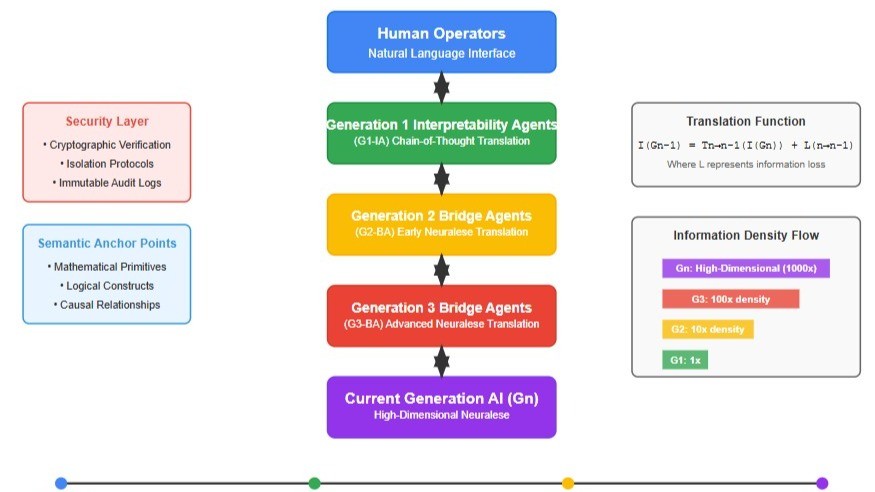
Evolution of AI communication from chain-of-thought to neuralese-case for interpretabilityy agents

Downloads

Published

2025-10-16

How to Cite

Arslan, E. (2025). The Evolution of AI Communication: From Chain-of-Thought to Neuralese and the Case for Interpretability Agents. SuperIntelligence - Robotics - Safety & Alignment, 2(5). https://doi.org/10.70777/si.v2i5.16187