
Soft Nationalization: How the US Government Will Control AI Labs
DOI:
https://doi.org/10.70777/si.v1i1.10931Keywords:
ai nationalization, ai governance, ai manhattan project, ai containment, artificial general intelligence, agi, situational awareness, ai arms raceAbstract
We have yet to see anyone describe a critical element of effective AI safety planning: a realistic model of the upcoming role the US government will play in controlling frontier AI.
The rapid development of AI will lead to increasing national security concerns, which will in turn pressure the US to progressively take action to control frontier AI development. This process has already begun1, and it will only escalate as frontier capabilities advance.
However, we argue that existing descriptions of nationalization2 along the lines of a new Manhattan Project3 are unrealistic and reductive. The state of the frontier AI industry — with more than $1 trillion4 in private funding, tens of thousands of participants, and pervasive economic impacts — is unlike nuclear research or any previously nationalized industry. The traditional interpretation of nationalization, which entails bringing private assets under the ownership of a state government5, is not the only option available. Government consolidation of frontier AI development is legally, politically, and practically unlikely.
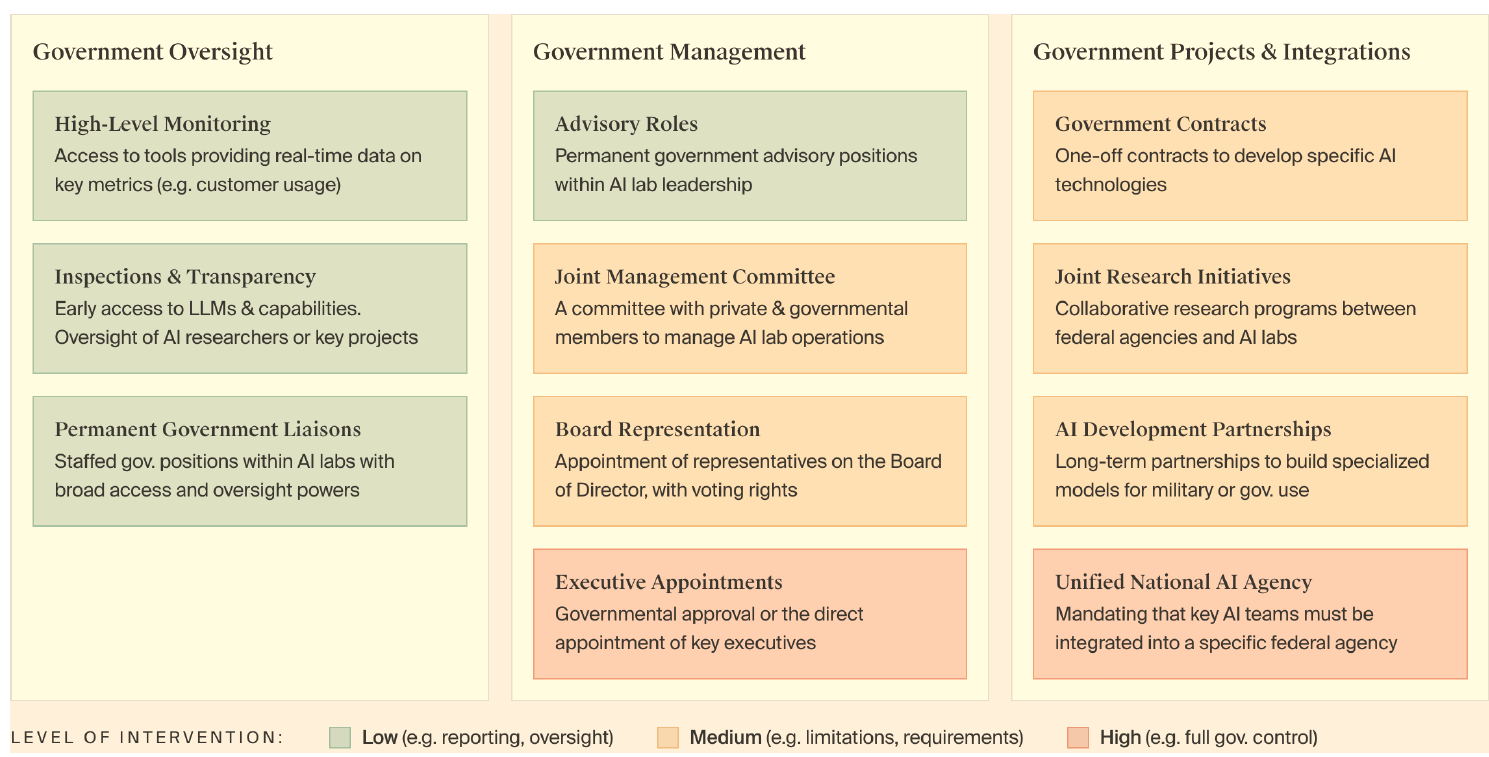
We expect that AI nationalization won't look like a consolidated government-led “Project”, but rather like an evolving application of US government control over frontier AI labs. The US government can select from many different policy levers to gain influence over these labs, and will progressively pull these levers as geopolitical circumstances, particularly around national security, seem to demand it.
Government control of AI labs will likely escalate as concerns over national security grow. The boundary between "regulation" and "nationalization" will become hazy. In particular, we believe the US government can and will satisfy its national security concerns in nearly all scenarios by combining sets of these policy levers, and would only turn to total nationalization as a last resort.
We’re calling the process of progressively increasing government control over frontier AI labs via iterative policy levers soft nationalization.
AUTHOR’S NOTE
It’s important to clarify that we are not advocating for a national security approach to AI governance, nor yet supporting any individual policy actions. Instead, we are describing a model of US behavior that we believe is likely to be accurate to improve the effectiveness of AI safety agendas.
References
1 US Semiconductor Export Controls
2 Let's nationalize AI. Seriously. - POLITICO
3 IV. The Project - Situational Awareness by Leopold Aschenbrenner
4 Will the $1 trillion of generative AI investment pay off? | Goldman Sachs
5 Nationalization - Wikipedia
6 The transformative potential of artificial intelligence - ScienceDirect
7 AI Index Report 2024 – Artificial Intelligence Index
8 Puts Power of State Behind AI—and Risks Strangling It - WSJ
9Newly Updated US Export Rules to China Target AI Chips | Altium
10 AI: How far is China behind the West? – DW – 07/24/2023
11 China is falling behind in race to become AI superpower | Semafor
12 Newly Updated US Export Rules to China Target AI Chips | Altium
13 How Artificial Intelligence Is Transforming National Security | U.S. GAO
14 An Overview of Catastrophic AI Risks
15 Ibid.
16 AI's economic peril to democracy | Brookings
17 Artificial intelligence and financial crises
18 For example: Bush’s The National Security Strategy of the United States of America . Or: Biden-Harris Administration's National Security Strategy
19 The Battle for Technological Supremacy: The US–China Tech War. Or: Global Strategy 2023: Winning the tech race with China .
20 We need to Pause AI, Pause Giant AI Experiments: An Open Letter
21 2007–2008 financial crisis - Wikipedia
22 Emergency Economic Stabilization Act of 2008 - Wikipedia
23 IV. The Project . Note that Leopold does allude to implementations that do not involve total nationalization, such as defense contracting or voluntary agreements. However, the majority of his argument is built around the idea of a fully centralized government-led research project.
24 AI and Geopolitics: How might AI affect the rise and fall of nations? | RAND
25 Competing Values Will Shape US-China AI Race – Third Way
26 Does Privatization Serve the Public Interest?
27 SAFE Innovation Framework
28 Companies ranked by Market Cap - CompaniesMarketCap.com
29 What you need to know about Nvidia and the AI chip arms race - Marketplace
30 Companies ranked by Market Cap - CompaniesMarketCap.com
31 See: Chips for Peace: How the U.S. and Its Allies Can Lead on Safe and Beneficial AI | Lawfare
32 A Typology of China's Intellectual Property Theft Techniques — 2430 Group
Downloads
Published
How to Cite
Issue
Section
License
Copyright (c) 2024 Deric Cheng, Corin Katzke

This work is licensed under a Creative Commons Attribution-NoDerivatives 4.0 International License.


